
The Smart Ecommerce Marketer's Guide to Strategic Ad Spending

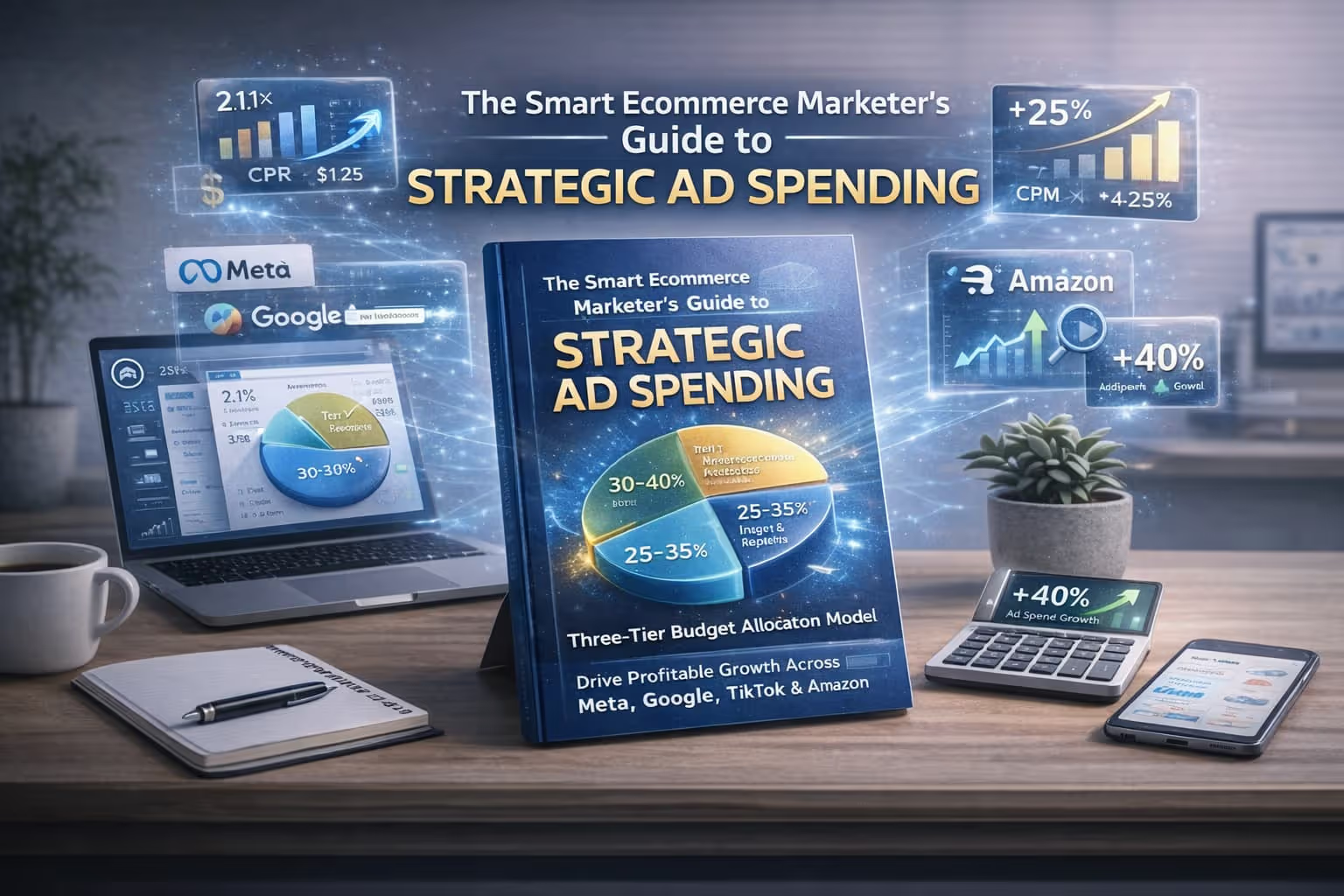
The Smart Ecommerce Marketer's Guide to Strategic Ad Spending
The Challenge Facing Ecommerce Marketers
Your Meta prospecting campaigns are burning through budget, but your cost per purchase keeps climbing. Your Google Shopping ads show a 2.1x ROAS, yet you still can't tell if you're actually making money.
You launched TikTok ads three months ago with a surge of clicks that converted into almost nothing. And now your CFO is asking why ad spend is up 40% while revenue only grew 15%.
Sound familiar?
The industry constantly debates tactics TikTok vs. Instagram, Google vs. Amazon, but experienced ecommerce marketers know the real challenge is strategic resource allocation. How do you drive profitable customer acquisition without burning cash?
Ecommerce brands face constant tension between growth and profitability: rising CPMs, iOS privacy changes, algorithm shifts, increasing competition, and customers scattered across dozens of touchpoints.
Every platform promises results, every agency promises scale, and yet most brands find themselves spending more to acquire less.
This guide cuts through the noise with three strategic decisions that separate profitable ecommerce advertisers from struggling ones:
- Budget Architecture: Allocating spend across platforms based on customer journey stage
- Platform Selection: Matching channels to your business model and customer behavior
- Campaign Optimization: Measuring what matters and scaling profitably
Smart ecommerce marketers don't spread budget evenly across platforms, they use strategic allocation models based on customer acquisition cost, lifetime value, and purchase intent signals. That's exactly what this guide will help you build.
The Three-Tier Budget Allocation Model
For ecommerce brands, ad budget isn't a monthly expense, it's growth infrastructure enabling profitable customer acquisition. Smart allocation follows the customer journey rather than spreading budget evenly. The brands winning in 2026 think in tiers.
The Strategic Allocation Framework
Tier 1: Top-of-Funnel Awareness (30–40% of budget)
- Platforms: Meta (Facebook/Instagram), TikTok, Pinterest, YouTube
- Goal: Build brand awareness and retargeting audience pools
- Expected ROAS: 0.5–2.0x (lowest immediate return, highest long-term value)
- Key metrics: CPM, cost per landing page view, engagement rate
This tier fills your funnel. Don't judge it on immediate ROAS, judge it on the quality and size of the audiences it builds for your lower-funnel campaigns.
Tier 2: Mid-Funnel Intent Capture (25–35% of budget)
- Platforms: Google Shopping, Search Ads, Amazon Sponsored Products
- Goal: Capture active purchase intent when customers are searching
- Expected ROAS: 2.0–3.5x (moderate returns, higher conversion rates)
- Key metrics: Conversion rate, cost per acquisition, search impression share
These are your demand-capture channels. When someone searches "best running shoes for flat feet," they're already in buying mode. Tier 2 is where you show up.
Tier 3: Bottom-Funnel Conversion (30–40% of budget)
- Platforms: Meta Retargeting, Google Display, cart abandonment campaigns
- Goal: Convert warm audiences who already know your brand
- Expected ROAS: 4–10x (highest returns, most cost-efficient)
- Key metrics: Purchase conversion rate, customer lifetime value, repeat purchase rate
This is your most efficient spend. These audiences have already shown intent, your job is to close.
Real-world application: For a DTC fitness equipment brand with a $60K monthly budget, one team allocated: $22K (37%) to Meta and TikTok prospecting, $16K (27%) to Google Shopping and Search, and $22K (36%) to retargeting and past-customer campaigns.
The result: a 4.1x blended ROAS while maintaining a 38% gross margin, well above their 30% profitability threshold.
Critical mistake to avoid: Many brands spend 70–80% of their budget on cold prospecting with minimal retargeting investment. Retargeting campaigns typically deliver 2–5x higher ROAS than cold prospecting, yet brands consistently underinvest here.
If you're spending less than 30% on bottom-funnel conversion, you're leaving money on the table.
Platform Selection as Strategic Decision
Matching Platforms to Your Business Model
Platform selection isn't about following trends, it's about strategic fit between your product, customer behavior, and where purchase decisions actually happen.
Product characteristics drive platform choice:
- Visual/lifestyle products (fashion, home decor, beauty) → Instagram, Pinterest, TikTok
- Problem-solution products (tech accessories, supplements) → Google Search, YouTube
- Commodity/price-sensitive (electronics, basics) → Amazon Ads, Google Shopping
- Impulse purchases (under $50) → TikTok, Instagram Stories
- Considered purchases (over $200) → Google Search, YouTube, email sequences
Target customer demographics:
- Gen Z (18–27) → TikTok, Instagram Reels
- Millennials (28–43) → Instagram, Facebook, YouTube
- Gen X/Boomers (44+) → Facebook, Google Search, Pinterest
- B2B buyers → LinkedIn Ads, Google Search
Decision matrix by business type:
Business Type
Primary Platform (Budget %)
Secondary Platforms (Budget %)
Fashion DTC
Instagram (40%)
TikTok (35%) + Google Shopping (25%)
Electronics Store
Google Shopping (50%)
Amazon Ads (30%) + Meta Retargeting (20%)
Supplement Brand
Google Search (40%)
YouTube (25%) + Meta (35%)
Platform-Specific Essentials
Google Ads Google remains the king of intent capture. Use Shopping campaigns for product visibility, Performance Max for automated cross-channel optimization, and Search campaigns for high-intent keywords.
Benchmarks to target: 2–5% CTR, 2–4% conversion rate, $0.50–$2.00 CPC.
Meta Advertising Meta's strength is audience building and retargeting. Run prospecting with interest targeting and lookalikes to fill your funnel, dynamic retargeting for website visitors and cart abandoners to close sales, and Advantage+ Shopping for automated optimization once you have enough conversion data.
Benchmarks: prospecting ROAS 1.5–2.5x, retargeting ROAS 4–8x.
Amazon Advertising If you sell products that Amazon carries, this isn't optional, it's defensive. Amazon captures 40% of US ecommerce, meaning customers will price-check there regardless.
Use Sponsored Products for keyword targeting and prioritize brand defense campaigns to protect your own listings from competitors.
TikTok Ads TikTok performs best for visual products under $100 with a younger target demographic. The critical rule: native, UGC-style content dramatically outperforms polished brand ads. Budget minimum of $500–$1,000/month for meaningful testing, anything less won't generate enough data to optimize.
Building Campaigns That Work as a System
The Four-Stage Campaign Architecture
Successful ecommerce advertisers don't run isolated tactics, they build campaigns that work together across the customer journey. Each stage feeds the next.
Stage 1: Awareness (Cold Traffic) Run prospecting campaigns, video content, and educational ads aimed at your ideal customer profile. Success metric: retargeting audience growth and cost per engagement under $0.50. Don't judge this stage on immediate ROAS, measure on audience quality.
Stage 2: Consideration (Warm Traffic) Show product-focused ads to engaged audiences, lean into benefit messaging and social proof. Success metric: add-to-cart rate over 5% and multiple page views per session. Your goal here is to educate and address objections before asking for the sale.
Stage 3: Conversion (Hot Traffic) Deploy cart abandonment sequences, limited-time offers, and dynamic retargeting. Success metric: purchase conversion rate over 3%. Critical timing note: retarget within 24 hours while intent is highest, delay and you lose them.
Stage 4: Retention (Past Customers) Run replenishment campaigns, new product launches, and cross-sells to your existing customer base. Success metric: repeat purchase rate over 25%. The math is simple, acquiring a new customer costs 5–25x more than retaining an existing one.
Integration example: A supplement brand uses prospecting Meta ads to drive quiz traffic, building retargeting pools segmented by health goal. Engaged users then see product ads tailored to their specific responses.
Cart abandoners enter a 48-hour sequence: Meta ad → email → SMS with a discount. Past purchasers receive automated replenishment reminders before they run out. This integrated approach delivered 42% higher customer lifetime value compared to single-touch campaigns.
Creative Execution That Converts
High-performing static ad structure: Lead with your hero product, pair it with a clear value proposition, add a trust element (reviews, guarantee, certifications), and close with a strong CTA.
The top-performing patterns: clean product showcase, before/after, product-in-use, and UGC. Data consistently shows UGC-style content performs 2.3x better than polished brand ads.
Video ad framework (15–30 seconds):
- 0–3 seconds: A hook that stops the scroll, don't ease in
- 3–8 seconds: Agitate the problem or desired outcome
- 8–20 seconds: Show the solution or product demonstration
- 20–30 seconds: Clear CTA with an incentive
Ad copy essentials:
- Headline: Lead with a specific benefit, not your product name. "Clearer Skin in 14 Days" outperforms "New Skincare Line" every time.
- Body: Address an objection or build credibility with social proof, a guarantee, or your unique advantage.
- CTA: Add an incentive to your action. "Shop Now – Free Shipping" converts better than a generic "Learn More."
Creative testing cadence: Launch 3–5 variations per campaign, refresh every 3–4 weeks to combat ad fatigue, monitor frequency (above 3.0 signals audience burnout), and maintain your winning concept while rotating execution.
Measurement & Optimization That Drives Profit
Metrics That Matter
Primary KPIs (business outcome focus):
ROAS (Return on Ad Spend) = Revenue ÷ Ad Spend Targets: Prospecting 1.5–2.5x | Retargeting 4–8x | Blended minimum 3–4x. Critical caveat: ROAS alone doesn't indicate profitability. A 4x ROAS with 20% margins may be losing money. Always layer in your margin data.
CAC (Customer Acquisition Cost) = Ad Spend ÷ New Customers Your CAC must be less than 33% of Customer Lifetime Value for sustainable growth. Industry benchmark range: $20–$150 depending on category and AOV.
Contribution Margin After Marketing = Revenue – COGS – Ad Spend – Fulfillment This is the metric that actually determines profitability. Target 25–40% for sustainable growth. If you're not tracking this, you're flying blind.
Secondary metrics to monitor:
- CPC: Targeting efficiency ($0.50–$2.00 benchmark)
- Conversion Rate: Website optimization health (2–4% benchmark)
- AOV: Bundle and pricing effectiveness
- LTV: Your LTV:CAC ratio should be a minimum 3:1
Leading indicators (early warning system):
- Rising CPM → Refresh creative or adjust targeting
- CTR decline → Creative fatigue or audience saturation
- Decreasing add-to-cart rate → Product page or pricing issues
- High bounce rate → Traffic quality problems
The Weekly Optimization Loop
Monday – Performance Review: Identify the top 20% and bottom 20% of campaigns. Document patterns in winning audiences and creative.
Tuesday – Budget Reallocation: Shift 10–20% of budget from underperformers to winners. Give campaigns a minimum of 7 days before cutting them.
Wednesday – Creative Refresh: Launch new variations for campaigns showing fatigue. Test one variable at a time for clean learnings.
Thursday – Audience Expansion: Add new targeting options to prospecting. Create lookalikes from your most recent converters.
Friday – Documentation & Planning: Record learnings and plan next week's tests. Update stakeholders on key metrics.
Monthly strategic review: Compare platform performance and shift budget allocation accordingly. Track CAC trends (is acquisition getting more or less expensive?). Analyze creative performance patterns and identify audience saturation signals.
Critical mistake: Over-optimization. Campaigns need 4–7 days to stabilize after any changes. Daily adjustments prevent algorithm learning and undermine statistical significance. Set it, monitor it, and let it breathe.
Common Pitfalls That Waste Budget
1. Spreading budget too thin Twenty campaigns at $50 each dramatically underperforms five campaigns at $200 each. Minimum viable spend: $500–$1,000 per platform per month to generate meaningful data.
2. Chasing ROAS while ignoring margins A 5x ROAS with 15% gross margins still loses money after fulfillment and overhead. Always calculate: Revenue – COGS – Ad Spend – Fulfillment = Actual Profit. ROAS is a signal, not a verdict.
3. Neglecting existing customers Retention campaigns deliver 2–3x better ROAS than prospecting. Acquiring a new customer costs 5–25x more than keeping an existing one. If you have no retention campaigns running, start today.
4. Poor mobile experience 70% of ecommerce traffic is mobile, yet most optimization attention goes to desktop. Page load time over 3 seconds loses 53% of visitors, fix your mobile experience before scaling ad spend.
5. Never refreshing creative Ad performance degrades 40–60% after 4–6 weeks. If you're running the same creative from last quarter, you're paying more for less. Refresh every 3–4 weeks minimum.
6. Misunderstanding attribution Last-click attribution over-credits bottom-funnel channels and dramatically undervalues awareness investment. The customer journey involves 6–8 touchpoints, last click gets credit, but earlier touches made it possible. Use data-driven attribution where available.
7. No systematic testing Random changes without documented hypotheses produce random results. Test one variable at a time, document your hypothesis, and wait for statistical significance before drawing conclusions.
Strategic Ad Spending in 2026
Smart ecommerce marketers allocate strategically across the customer journey, 30–40% to awareness, 25–35% to intent capture, 30–40% to conversion and retention.
They match platforms to their specific business model and customer behavior. And they build integrated campaigns that compound over time rather than isolated tactics that produce one-time spikes.
Ecommerce advertising is more competitive than ever. Rising costs and privacy changes mean brands can't rely on spray-and-pray tactics. Strategic frameworks and systematic optimization are what separate profitable growth from cash-burning vanity metrics.
Most ecommerce brands still advertise reactively, chasing trends, spreading budgets thin, and neglecting retention. The opportunity for brands willing to implement strategic frameworks is enormous, and the advantage compounds over time.
Start here: Audit your current budget allocation against the three-tier model. Where are you over-investing? Where are you leaving money on the table? Use those insights to restructure for profitable growth.
The difference between profitable and struggling ecommerce advertisers isn't access to secret tactics, it's disciplined execution of strategic fundamentals. Master allocation, platform selection, and systematic optimization, and you'll consistently outperform competitors chasing whatever trend came out this week.