
How Blaze AI Helps Manufacturers Improve Efficiency Across Their Workflows

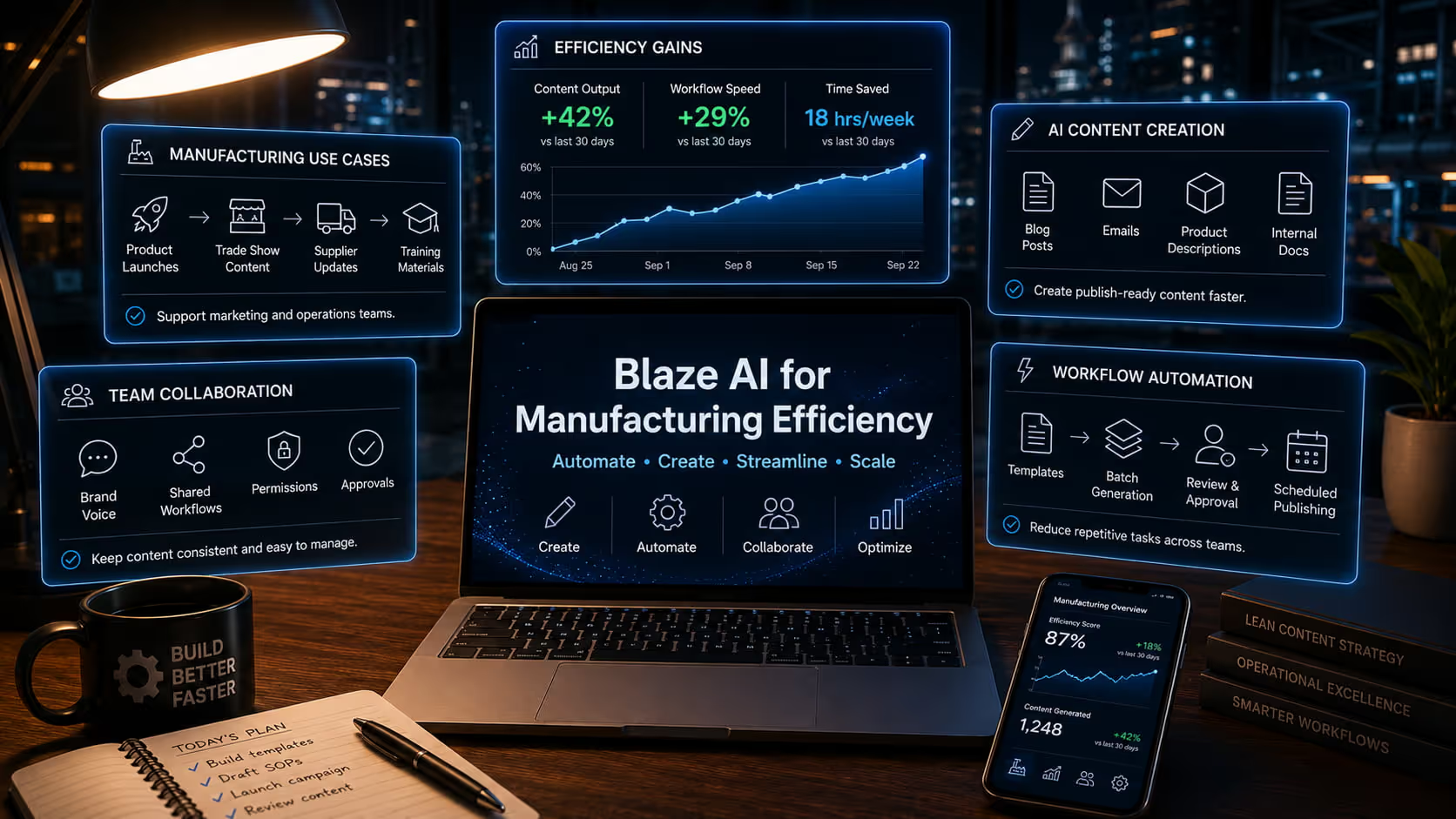
How Blaze AI Helps Manufacturers Improve Efficiencies
Manufacturing teams are under constant pressure to do more with less. Blaze AI gives production, marketing, and operations teams a platform to automate repetitive tasks, speed up content creation, and improve workflow efficiency without adding headcount.
This article walks through how manufacturing companies are applying Blaze AI tools to drive real efficiency gains.
What Is Blaze AI and Why Do Manufacturing Teams Use It?
Blaze AI is an AI-powered content and workflow platform built to help teams produce more output in less time. For manufacturing companies, where resources are often stretched thin and marketing or operations staff wear multiple hats, Blaze AI serves as a force multiplier that removes the bottlenecks slowing teams down.
At its core, Blaze AI handles the heavy lifting of content creation. It drafts blog posts, emails, social media updates, product descriptions, internal documentation, and more, all aligned to your brand voice.
The platform includes a suite of AI writing tools, customizable templates, batch generation capabilities, and collaboration features that make it practical for real business workflows, not just one-off experiments.
Manufacturing teams use Blaze AI because it directly addresses their most common pain points: not enough time, not enough staff, and not enough budget to produce the volume of content modern marketing and operations demand.
With Blaze AI, teams report significant time savings on content production, measurable gains in workflow efficiency, and a lower cost per piece of output compared to outsourcing or hiring.
Blaze AI is built for lean teams, small marketing departments, and operations professionals who need enterprise-level output without enterprise-level resources.
Blaze AI Features That Drive Manufacturing Efficiencies
AI-Assisted Content Creation Tools
Blaze AI's writing tools are designed to generate publish-ready content quickly. Teams can produce full blog posts and long-form articles in a fraction of the time it would take to write from scratch. Email campaigns, social media drafts, and ad copy can be generated in bulk, reviewed, and scheduled without the usual back-and-forth.
For manufacturing companies, this matters most when launching new products, promoting trade show appearances, or maintaining a consistent content calendar without a dedicated content team.
Blaze AI keeps copy on-brand by learning your preferred tone, terminology, and messaging, so output sounds like your company, not a generic AI.
Workflow Automation Inside Blaze
Beyond writing, Blaze AI is built around workflow efficiency. Teams can create custom templates for their most common content types, product announcements, supplier updates, safety communications, so that every new piece starts from a proven structure rather than a blank page.
Batch content generation allows teams to produce multiple variations or multiple pieces simultaneously, which is especially useful for campaigns targeting different customer segments or regional markets.
Scheduled publishing workflows mean content can be prepared in advance and go out automatically, reducing the daily operational burden on small teams.
Team Collaboration and Brand Management
Blaze AI includes shared brand voice settings that keep everyone producing consistent content, regardless of who is writing on a given day. Multi-user access controls allow managers to set permissions for different team members, so junior staff can draft while senior staff review and approve.
The built-in content review and approval workflow eliminates the need for external tools or email chains. Everything stays inside the platform, making collaboration faster and easier to track.
Real Use Cases: Manufacturing Teams Using Blaze AI
Marketing and Demand Generation Teams
Manufacturing marketers are using Blaze AI to run campaigns that previously would have required agencies or larger in-house teams. Campaign content from landing pages to follow-up email sequences can be produced and iterated quickly.
Product launch materials that once took weeks to coordinate can be drafted, reviewed, and finalized in days.
Trade show collateral is another high-impact use case. Blaze AI helps teams generate booth copy, product one-pagers, follow-up sequences, and social content around events without pulling resources from other priorities.
Operations and Internal Communications
Efficiency gains are not limited to external marketing. Operations teams are using Blaze AI to document processes, draft standard operating procedures, and create training materials. Writing that used to fall to whoever had time, or never got done at all, can now be completed quickly and consistently.
Vendor and supplier communications, often repetitive and time-consuming, can be templated and generated at scale. Whether it's a routine update, a request for proposal, or a compliance document, Blaze AI reduces the time spent on writing so teams can focus on the work itself.
Small Manufacturing Teams with Limited Staff
For small manufacturers where one person handles marketing, Blaze AI changes what is possible. A single team member can manage a full content calendar, run email campaigns, maintain social media, and support sales tasks that would typically require a team of three or four.
This is the force multiplier effect in practice. Blaze AI does not replace judgment or strategy, but it removes the execution bottleneck that keeps small teams from doing more. For manufacturers trying to grow without growing headcount, that is a meaningful competitive advantage.
How to Get Started with Blaze AI for Manufacturing Efficiency
Setting up Your Blaze AI Account
Getting started with Blaze AI is straightforward. Create an account on the Blaze AI website and select the plan that fits your team size and usage needs. From there, the most important setup step is configuring your brand voice.
This involves inputting information about your company's tone, industry terminology, and preferred style so that all generated content reflects your brand from the start.
Adding team members is simple, invite colleagues via email, assign roles, and set permissions based on who needs to create, review, or approve content.
Tips for Getting the Most from Blaze AI
Use templates for every repeatable content type. If you send a monthly customer newsletter, a product update email, or a quarterly supplier communication, build a template for it once and reuse it. Consistency improves and production time drops.
Train Blaze on your brand voice early and revisit it as your messaging evolves. The more specific you are about your tone and terminology, the more usable the output will be out of the gate.
Always review output before publishing. Blaze AI dramatically accelerates production, but human review remains important, especially for technical accuracy, compliance language, or anything that will represent your company publicly.
Frequently Asked Questions
Which AI is Best for the Manufacturing Industry?
The answer depends on the use case. Manufacturing companies use AI for many different purposes, predictive maintenance, supply chain optimization, quality control, and content production are all separate categories with different tool requirements.
For content creation and workflow efficiency, Blaze AI is one of the strongest options available. It is built specifically for teams that need to produce marketing materials, internal documentation, and communications at scale. For operational data analysis or production floor applications, other specialized tools are more appropriate.
The best approach is to identify your highest-priority efficiency gap and evaluate tools against that specific need rather than looking for a single platform to solve everything.
What Is Better Than Blaze AI?
That depends entirely on what you need. Blaze AI excels at content creation, brand consistency, team collaboration, and workflow automation for marketing and communications teams. If those are your priorities, it performs well against alternatives.
Competitors in the AI writing and workflow space include tools like Jasper, Copy.ai, and broader platforms like HubSpot's AI features. Each has different strengths. Jasper tends to be favored by larger enterprise marketing teams.
Copy.ai is often compared for similar use cases. Blaze AI differentiates itself with its combination of brand voice management, team collaboration features, and workflow automation in a single platform.
If your primary need is something outside content, such as ERP integration, production scheduling, or data analytics, then Blaze AI is not the right comparison point and you should evaluate tools built for those specific functions.
Is Blaze AI Legitimate?
Yes. Blaze AI is an established platform with a real customer base and documented use cases across industries. Customer reviews on platforms like G2 and Capterra provide third-party validation of the product's performance and reliability.
On data and privacy, Blaze AI maintains standard data protection practices. As with any AI tool you introduce to your business, it is worth reviewing their privacy policy and data handling terms, particularly if you are inputting proprietary product information, internal documents, or customer data into the platform.
What Is the 30% Rule in AI?
The 30% rule is a guideline that suggests AI-generated content should be reviewed and edited by a human to ensure at least 30% of the final output reflects human input, judgment, or refinement.
The intent is to prevent fully automated content from going out without oversight, which can lead to factual errors, off-brand messaging, or content that lacks the nuance a human writer would catch.
In a manufacturing context, this rule is especially relevant for technical documentation, compliance materials, and customer-facing product content where accuracy is non-negotiable.
Blaze AI accelerates production significantly, but the 30% rule is a useful reminder that the platform works best as a collaboration between AI speed and human expertise, not as a fully autonomous publishing machine.