
Streamlining Manufacturing Workflows Using AI from Blaze.ai

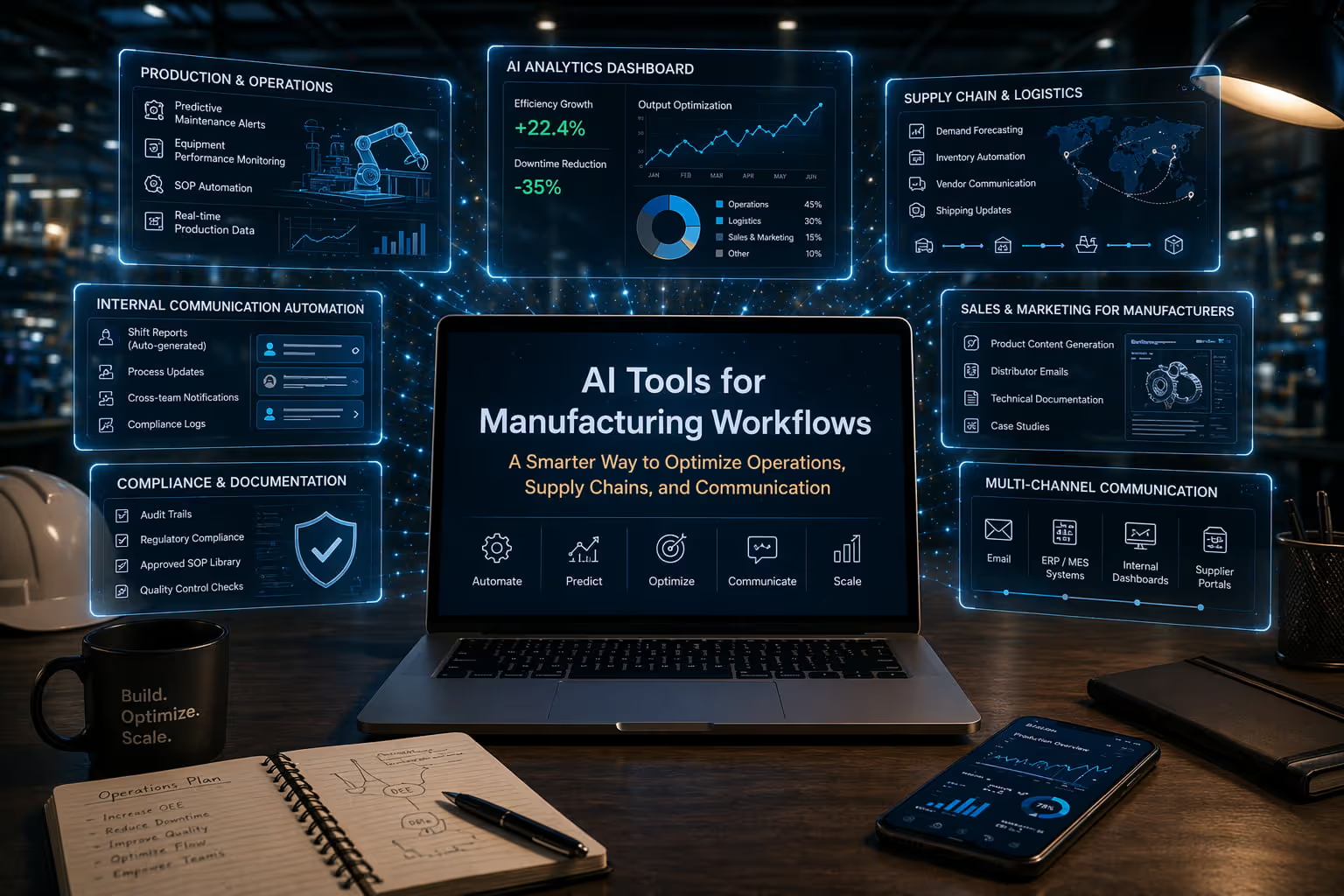
Streamlining Manufacturing Workflows Using AI: A Practical Guide for Modern Manufacturers
Manufacturing has always been about precision, precise tolerances, precise timing, precise output. But in an era defined by global supply chains, accelerating customization demands, and relentless competitive pressure, precision alone isn't enough.
Modern manufacturers need speed, adaptability, and scale and that's exactly what AI delivers.
Streamlining manufacturing workflows using AI isn't a future-state ambition. It's happening now, across shop floors, supply chains, and sales departments at manufacturers of every size.
This guide breaks down what that looks like in practice, where the biggest gains are hiding, and how platforms like Blaze.ai are helping manufacturing teams scale without adding headcount.
Why Manufacturing Workflows Need Optimization Now
The manufacturing sector is under more pressure than at any point in recent memory. Margins are tighter, timelines are shorter, and the complexity of running a modern manufacturing operation has grown exponentially. If your workflows haven't evolved to meet that complexity, you're already behind.
Increasing Operational Complexity
Today's manufacturers aren't running a single plant with a predictable product line. They're managing multi-site production networks, coordinating with global supply chains, and responding to customers who demand increasing levels of customization, often with shorter lead times than ever before.
Each layer of complexity introduces new opportunities for miscommunication, delay, and error. Managing that complexity with manual processes, spreadsheets, and siloed teams isn't just inefficient, it's unsustainable.
Inefficiencies in Traditional Workflows
Legacy workflows weren't built for this environment. Manual documentation slows down process updates and creates compliance risk.
Siloed communication between operations, sales, and logistics causes decisions to be made without the right information. Slow reporting cycles mean leaders are reacting to last week's problems instead of anticipating tomorrow's.
These aren't minor inconveniences. They translate directly to missed shipments, rework costs, customer churn, and lost contracts.
Competitive Pressure to Digitize
Industry 4.0 is no longer a concept being debated in boardrooms, it's a standard that leading manufacturers are actively implementing. Smart factory initiatives, IoT-connected equipment, and real-time decision-making infrastructure are becoming table stakes in competitive markets.
Manufacturers who delay digital transformation in manufacturing risk ceding ground to competitors who can respond faster, operate leaner, and deliver more consistently. AI workflow optimization is a core component of that transformation, not a nice-to-have, but a competitive requirement.
What It Means to Streamline Manufacturing Workflows Using AI
Before diving into applications, it's worth being precise about what streamlining manufacturing workflows using AI actually means, because the term gets used loosely.
Workflow Automation
At its most fundamental, AI-driven workflow automation replaces repetitive manual tasks with intelligent, rule-based, or model-driven processes.
That means standardizing how information flows through your organization, reducing the human effort required for routine tasks, and dramatically cutting the error rates that come with manual execution.
Think: automatically generated shift reports, AI-drafted SOPs that update when processes change, or vendor communication that goes out on schedule without someone manually writing every message.
Intelligent Data Utilization
Manufacturing generates enormous amounts of operational data. AI in manufacturing turns that data into something actionable, surfacing patterns, flagging anomalies, and enabling predictive decision-making that reactive reporting cycles simply can't support.
Real-time monitoring powered by AI doesn't just tell you what happened. It tells you what's likely to happen next and gives your teams the context to act before a small issue becomes a major disruption.
Cross-Department Efficiency
One of the most underappreciated benefits of smart manufacturing solutions is what they do at the intersection of departments. Operations, sales, and marketing in manufacturing organizations often operate in near-complete isolation, with production schedules disconnected from sales pipeline data, and marketing teams creating content without real input from the shop floor.
AI workflow optimization bridges those gaps, aligning teams around shared data, faster communication cycles, and execution timelines that actually reflect operational reality.
Key Areas Where AI Improves Manufacturing Workflows
The impact of AI in manufacturing isn't confined to a single department. Here's where smart manufacturing solutions are delivering measurable results across the organization.
Production & Operations
On the production side, manufacturing process automation is accelerating every stage of the operations cycle. AI tools can analyze production data to identify optimization opportunities, flag equipment performance trends before they become failures, and generate predictive maintenance alerts that get communicated to the right people in a format they can act on immediately.
Beyond maintenance, AI is transforming how manufacturers create and maintain standard operating procedures. Instead of SOPs that sit in binders and go stale, AI-generated documentation can be updated continuously to reflect current processes, formatted consistently, and distributed across teams without manual effort.
Supply Chain & Logistics
Supply chain volatility has exposed just how fragile manual logistics workflows can be. AI workflow optimization helps here by improving demand forecasting communication, ensuring that procurement, production planning, and logistics teams are working from the same projections and by automating vendor coordination messaging so that supplier relationships are maintained without the bottleneck of manual outreach.
Inventory updates, shipping confirmations, and exception alerts can all be automated and routed intelligently, reducing the communication lag that causes supply chain disruptions to cascade.
Sales & Marketing for Manufacturers
This is an area that many manufacturers underinvest in and where AI in manufacturing can generate outsized returns. Product content creation, case study development, technical spec sheets, and email campaigns for distributor networks are all content-heavy tasks that traditionally require significant time investment.
With AI, manufacturers can produce high-quality product descriptions, technical content, and distributor communications at a fraction of the time and cost without sacrificing accuracy or brand consistency. Digital transformation in manufacturing isn't just about the shop floor. It extends to how manufacturers go to market.
Internal Communication
Shift updates, performance summaries, cross-department announcements the internal communication burden in a manufacturing operation is relentless.
AI can automate the generation and distribution of this content layer, ensuring that the right information reaches the right people at the right time without relying on individuals to manually compile and send reports.
The result is a more informed workforce, faster response to operational changes, and less time spent on communication overhead that adds no direct value to production.
How Blaze.ai Helps Streamline Manufacturing Workflows
Blaze.ai is purpose-built for exactly the workflow challenges that manufacturing teams face: high content volume, cross-department coordination, speed-to-execution demands, and the need to scale communication without scaling headcount.
AI-Generated Operational Content
Blaze.ai enables manufacturing teams to generate SOPs, internal documentation, training guides, and process update communications with AI that understands your operational context.
Instead of spending hours drafting and reformatting documentation, teams can produce accurate, on-brand content in minutes and update it as processes evolve.
This is particularly valuable in environments where regulatory compliance, safety protocols, and process standardization require consistent, well-documented procedures across every site and every shift.
Marketing & Sales Enablement for Manufacturers
Blaze.ai gives manufacturers a scalable content engine for sales and marketing outputs that traditionally bottleneck growth. Product descriptions, technical content for distributor catalogs, and outbound communications to dealer networks can all be generated, customized, and deployed at scale.
For manufacturers competing on both product quality and customer experience, this kind of smart manufacturing solution closes the gap between what your operation can produce and how effectively it's communicated to the market.
Multi-Channel Communication Automation
Blaze.ai supports automation across every communication channel that matters to a manufacturing operation email updates to suppliers and customers, internal announcements to production and logistics teams, and external campaign content for distributor and partner networks.
Rather than managing each channel separately with manual effort, manufacturers can centralize content creation and automate distribution, ensuring consistency and speed across every touchpoint.
Faster Execution Across Departments
The operational bottleneck in most manufacturing organizations isn't a lack of information it's the time it takes to convert information into action. Blaze.ai removes that bottleneck by enabling faster content creation and communication execution across departments.
Operations teams can communicate process changes without the document creation delay. Sales teams can respond to RFPs with technical content generated in hours instead of days.
Marketing teams can keep distributor networks informed without a full production cycle for every campaign. The result is a leaner, faster-moving organization that can scale communication without adding headcount a core advantage in a competitive manufacturing environment.
Compliance Considerations When Using AI in Manufacturing
Introducing AI into manufacturing workflows raises legitimate compliance and quality control questions. The right approach isn't to avoid AI it's to implement it with the right guardrails.
Importance of Human Review
AI-generated content and automated workflows should always include checkpoints for human review, particularly in areas touching safety documentation, regulatory compliance, and customer-facing communications. AI accelerates execution; human judgment ensures accuracy and accountability.
Using Pre-Approved Messaging Frameworks
For manufacturers operating in regulated industries, food and beverage, pharmaceuticals, automotive pre-approved messaging frameworks ensure that AI-generated content stays within compliance boundaries. Blaze.ai allows teams to build from templates and brand guidelines that keep outputs consistent and defensible.
Maintaining Recordkeeping & Audit Trails
Automated workflows need to be auditable. Whether for ISO compliance, customer audits, or internal quality reviews, maintaining clear records of what was communicated, when, and by whom is non-negotiable. AI workflow tools should support, not circumvent, those recordkeeping requirements.
Avoiding Misleading or Unverified Claims
In technical industries, content accuracy matters. AI-generated product descriptions, spec sheets, and technical documentation must be reviewed against verified data before publication.
Establishing review workflows that pair AI speed with human verification protects both compliance and brand credibility.
Common Mistakes When Implementing AI in Manufacturing Workflows
AI in manufacturing delivers significant returns but only when implemented thoughtfully. These are the most common pitfalls to avoid.
Treating AI as a Full Replacement Instead of an Augmentation Tool
AI doesn't replace the expertise of experienced operations managers, engineers, or sales leads. It amplifies their capacity. Organizations that attempt to eliminate human judgment from the workflow in pursuit of full automation typically end up with outputs that are fast but unreliable.
The right model is augmentation: AI handles volume and speed, humans handle judgment and verification.
Poor Data Inputs Leading to Weak Outputs
The quality of AI outputs is directly tied to the quality of inputs. Manufacturers who feed AI tools with inconsistent data, outdated documentation, or poorly defined process parameters will get weak outputs and attribute the failure to the technology rather than the input quality.
Getting your data and process documentation in order before scaling AI adoption is essential.
Lack of Cross-Team Adoption
Digital transformation manufacturing initiatives frequently stall because adoption is uneven across departments. If operations embraces AI workflow optimization but sales and marketing don't, you haven't solved the silo problem you've just created a new one.
Driving adoption across departments from the outset is critical to realizing the full value of manufacturing process automation.
Ignoring Change Management
AI implementation is a change management challenge as much as a technology challenge. Teams that have operated with established manual workflows for years will need clear communication about why change is happening, what it means for their roles, and how to use new tools effectively.
Investing in change management is not optional it's what separates successful smart manufacturing solutions rollouts from failed ones.
The ROI of Streamlining Manufacturing Workflows Using AI
Manufacturers are results-driven. Here's what the ROI of AI workflow optimization looks like in measurable terms.
Reduced Operational Delays
Automating communication, documentation, and reporting removes the manual handoffs that slow down every stage of the production and logistics cycle. Fewer delays means fewer missed commitments and stronger customer relationships.
Improved Productivity
When teams spend less time on repetitive documentation and communication tasks, they have more capacity for high-value work. Manufacturing process automation consistently shows productivity gains not by pushing people harder, but by eliminating the low-value work that crowds out strategic execution.
Lower Error Rates
Manual processes are error-prone by nature. Standardized, AI-generated documentation and communication reduces variability and the costly mistakes that come with it whether that's a miscommunicated process update or an incorrect product specification in a distributor catalog.
Faster Time-to-Market
From product launches to process rollouts to distributor communications, AI in manufacturing compresses timelines across every function. Faster time-to-market is a direct competitive advantage in industries where speed is increasingly a differentiator.
Before vs. After: A Snapshot
Workflow Area
Before AI
After AI
SOP creation
2–3 days per document
30–60 minutes with review
Distributor email campaigns
1 week per campaign
Same-day execution
Shift reports
Manual compile, 45+ min
Automated, delivered on schedule
Vendor coordination
Individual emails, reactive
Automated updates, proactive
Product content
Bottlenecked on 1–2 writers
Scalable across teams
Future Trends: AI and the Next Phase of Manufacturing Efficiency
Streamlining manufacturing workflows using AI is already delivering results. The next phase will be even more transformative.
Fully Integrated Smart Factories
The smart factory of the near future isn't just automated it's interconnected. Every system, from production equipment to supply chain platforms to customer-facing channels, shares data and communicates intelligently. AI is the connective tissue that makes that integration possible.
Real-Time AI-Driven Decision Systems
Real-time decision-making is moving from aspiration to operational standard. AI-driven systems that monitor production, logistics, and market conditions simultaneously will give manufacturers the ability to make faster, better-informed decisions at every level of the organization.
Predictive Workflow Automation
Beyond reacting to operational events, predictive workflow automation will anticipate them. AI systems will identify patterns in production data, supply chain behavior, and customer demand that enable manufacturers to adjust workflows proactively, before disruptions occur.
Deeper Integration with ERP and MES Systems
The most significant near-term opportunity for AI workflow optimization lies in deeper integration with the ERP and MES systems that manufacturers already run their operations on.
As AI tools become native to those platforms, the gap between operational data and actionable communication will close, making digital transformation manufacturing a continuous capability rather than a discrete initiative.
Final Thoughts: AI as a Workflow Multiplier for Manufacturers
Streamlining manufacturing workflows using AI isn't about replacing the people who make your operation run. It's about multiplying what they can accomplish, reducing friction, accelerating execution, and giving every team the information and tools they need to perform at their best.
The manufacturers who will lead their markets over the next decade are the ones investing now in smart manufacturing solutions that scale.
Not just on the shop floor, but across supply chains, sales teams, marketing functions, and every point of communication that defines how well your organization operates and how effectively it grows.
Blaze.ai is built for that challenge. Whether you're looking to automate operational documentation, scale distributor communications, or bring cross-department content execution under a single, AI-powered platform, Blaze.ai gives manufacturing teams the tools to move faster, operate leaner, and compete at scale.
Ready to see what AI workflow optimization looks like for your operation? Explore what Blaze.ai can do for your manufacturing business.