
AI Tools for Travel Agents | Blaze.ai

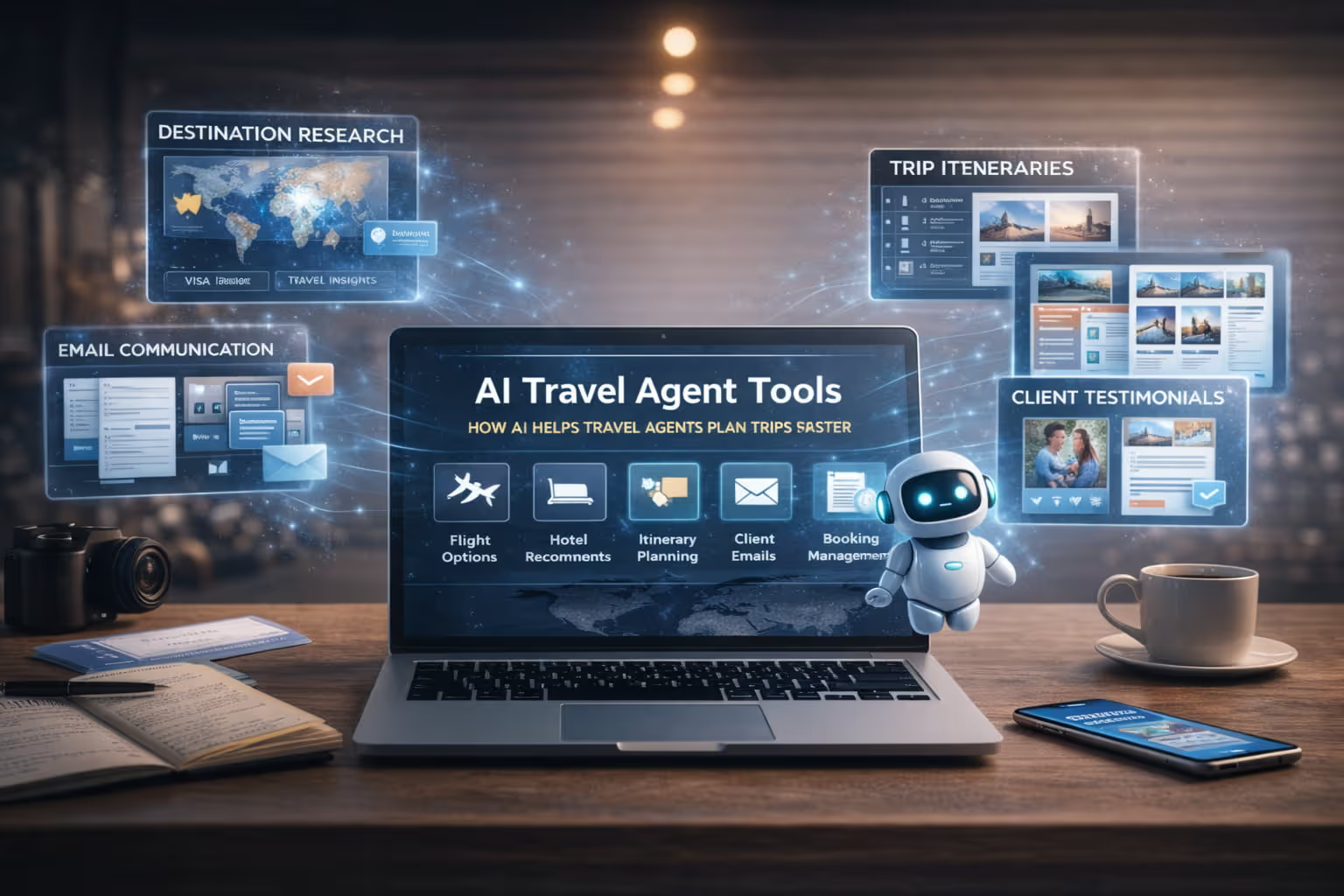
AI Tools for Travel Agents: Best Tools, Use Cases, and Workflows
Clients expect responses the same day they reach out. They want itineraries that feel custom-built for them, not pulled from a template. And they're comparing your service against booking platforms that surface options in seconds. For travel agents, that pressure is real and it's not going away.
AI tools don't change what makes a great travel agent: local knowledge, trusted supplier relationships, and the ability to read what a client actually wants versus what they're asking for.
What they do change is how quickly you can move from intake to proposal, how easily you can keep up with content and communication, and how much of the administrative weight you're carrying by hand.
This guide covers the AI tools most relevant to travel agents right now, how to think about using them across research, planning, writing, and marketing, and what to watch for when building them into your workflow.
Why AI Tools Matter for Travel Agents Today
The shift toward AI in travel agency work isn't driven by hype it's driven by a specific set of pressures that have been building for years.
Client expectations have accelerated. The same clients who use Airbnb and Google Flights for research are now used to instant results. When they reach out to a travel agent, they're not always willing to wait 48 hours for a proposal. Speed has become a baseline expectation, not a differentiator.
Personalization is harder to deliver at scale. One of the core value propositions of working with an agent is getting recommendations tailored to you your travel style, budget, pace, and interests. That's easy to deliver for five clients. It's much harder when you're managing twenty active inquiries at once.
Solo agents and small teams can't just add headcount. Hiring staff to handle overflow isn't always practical. AI tools offer a way to extend capacity without changing the cost structure of a business handling research drafts, email follow-ups, social captions, and itinerary outlines in far less time than doing it all manually.
Content marketing has become a real growth channel. More travel agents are building audiences through Instagram, YouTube, and newsletters. Keeping up with that content cadence while running a full client book is genuinely difficult.
AI tools are helping agents who want to invest in long-term brand building without dedicating entire days to writing.
The result is a growing category of tools that, when used well, help agents do more of what they're good at and less of the time-intensive work that gets in the way.
What Travel Agents Can Actually Use AI For
Before getting into specific tools, it's worth grounding the category in the actual jobs travel agents need to get done. AI isn't useful in the abstract it's useful when it maps to a real task in your day-to-day workflow.
Researching Destinations and Options Faster
A client asks about a two-week trip through Southeast Asia. You have a general sense of the region, but you need to quickly pull together current information on visa requirements, the best times to be in each city, transportation logistics between destinations, and accommodation tiers across budget levels.
Doing this from scratch through browser tabs is slow.
AI tools can accelerate this significantly. A well-prompted AI assistant can summarize destination logistics, compare route options, flag common traveler pain points for a region, and surface questions worth verifying all in the time it would take to read two or three blog posts.
That doesn't replace your expertise; it gives you a faster starting point to refine with it.
Building Itineraries and Trip Proposals
Day-by-day itinerary drafting is one of the most time-consuming parts of the job. Even for destinations you know well, translating that knowledge into a structured, readable proposal takes time.
AI tools can generate initial itinerary drafts that you then edit, customize, and refine with actual supplier relationships and on-the-ground knowledge.
The output isn't the final product it's a working draft that shortens the distance between inquiry and polished proposal. For agents handling multiple simultaneous trips, that compression matters.
Writing Emails and Client Follow-Ups
Travel agent communication involves a lot of repetitive-but-important emails: confirmation messages, post-booking checklists, pre-departure reminders, follow-ups after a trip, requests for reviews, and check-ins during planning. These messages need to feel personal even when the underlying structure is consistent.
AI writing tools can draft these quickly, adapting tone and detail to the specific client and trip. You review, adjust the personal details, and send instead of writing from scratch each time.
Creating Marketing Content for a Travel Business
Blog posts about destination guides, Instagram captions for recent trips, newsletters with seasonal travel ideas, Pinterest descriptions, YouTube video scripts this is all content that helps travel agents attract clients organically over time. It's also content that most agents simply don't have hours to produce.
AI tools make it possible to batch this work. A single session can generate a draft blog post, five social captions, and a newsletter intro all based on a topic or recent client trip you describe. The tone and voice still need to be yours, but the blank page problem is gone.
The Main Types of AI Tools for Travel Agents
Not all AI tools serve the same purpose. Here's how to think about the category by use case.
AI Itinerary Planners
These tools are designed specifically to help structure trip proposals and day-by-day itineraries. Some are built for agents, others for direct-to-consumer use, but the underlying function is similar: input trip parameters (destination, length, group type, interests, budget range) and receive a structured itinerary draft.
Tools in this category include Layla, Wonderplan, TripPlanner AI, and general-purpose AI assistants like ChatGPT and Claude, which can generate detailed itineraries through well-crafted prompts. The agent-specific tools often integrate with booking platforms or supplier databases, adding practical utility beyond the draft.
What to watch: AI itinerary tools don't have real-time data on availability, pricing, or current conditions. Everything they produce needs to be verified before it reaches a client. Use them to structure a proposal quickly, then fill in the accurate details yourself.
AI Writing and Content Tools
This category covers tools primarily focused on producing written output emails, proposals, blog posts, social content, and website copy. They range from general writing assistants to tools with features built specifically for service businesses and agencies.
ChatGPT and Claude are the most flexible options here, capable of drafting nearly any kind of client-facing or marketing content when given clear prompts. Jasper offers more structured templates for marketing use cases.
Blaze.ai is specifically designed to help businesses produce consistent content across channels more on that in the final sections.
For travel agents, writing tools are most useful when you have a clear brief to feed them: the destination, the tone, the audience, and the goal of the piece. The better the input, the more usable the output.
AI Assistants for Admin and Workflow Support
Some AI tools are more useful for the background work of running a travel business than for the client-facing output. This includes tools that help organize notes and research, summarize long documents, manage to-do lists, or build repeatable workflows.
Notion AI integrates into a workspace many agents already use for CRM and trip planning notes, adding summarization and drafting features within the same environment.
Otter.ai transcribes and summarizes calls, which is useful for agents doing a lot of discovery conversations by phone or video. Zapier's AI features can help automate repetitive handoffs like turning a completed inquiry form into a briefing note or a follow-up task.
These tools don't produce the deliverables clients see, but they reduce the operational overhead of running an organized, responsive travel business.
AI Tools for Marketing and Lead Generation
Travel agents who are investing in content marketing blog posts, newsletters, social media, video scripts need a way to produce that content consistently without it consuming the whole week. AI marketing tools are designed to make that cadence sustainable.
Blaze.ai is built specifically for this: it helps businesses plan, write, repurpose, and publish content across channels. For a travel agent who wants to turn a recent client trip into a blog post, three Instagram captions, and a newsletter section, Blaze can compress that work significantly.
Other tools in this category include Buffer's AI assistant for social scheduling, Canva's AI design features for visual content, and Beehiiv's AI tools for newsletter operators. The right combination depends on which channels matter most for your audience.
How Travel Agents Should Choose the Right AI Tools
The travel industry is full of tools making big promises. These are the criteria that actually matter when deciding what to integrate.
Look for Speed Without Sacrificing Personalization
The whole point of using AI is to move faster. But if the output requires so much editing to feel personal that it takes as long as writing from scratch, the tool isn't helping.
Evaluate tools not by the quality of their raw output, but by how much usable content they get you per hour spent. A tool that generates a 70% draft you can polish in ten minutes beats one that generates a technically impressive 50% draft that still needs an hour of work.
Choose Tools That Fit Your Existing Workflow
The best AI tool is one you'll actually use. If you live in Notion, a tool that integrates there will see far more use than one that requires opening a separate browser tab and switching contexts.
Think about where in your day you have the most friction research, writing, email and look for tools that reduce that friction within the environment you already work in.
Keep Human Review in the Process
This is non-negotiable. AI tools make mistakes. They confidently state outdated visa requirements. They hallucinate hotel names. They give travel times that don't account for realistic conditions.
For anything client-facing itineraries, proposals, pricing information, logistics human review isn't optional. Build AI into a draft-and-review workflow, not a generate-and-send one.
Your professional reputation depends on the accuracy of what you put in front of clients, and AI tools don't share that accountability with you.
The Rise of AI Travel Agents and AI-Powered Trip Planning
The travel industry is entering a new era where ai travel technology works alongside human agents rather than replacing them. Instead of relying only on traditional methods and hours of manual work, modern travel agency operations increasingly rely on ai powered tools, ai agents, and automation tools to streamline trip planning, research destinations, and manage the booking process with far less hassle.
At the center of this shift are ai travel agents and ai travel assistants that can support agents by handling the heavy lifting behind the scenes.
These systems use generative ai, large datasets, and real-time travel data to assist with travel booking, identify flight options, monitor pricing trends, and surface the best deals across flights, hotels, and other services used by travelers.
For tour operators, travel companies, and independent advisors running a travel agency, the goal isn’t to replace expertise. Instead, it’s about integrating ai so that agents can focus on strategy, personalization, and building stronger relationships with clients.
How AI Trip Planners Support Travel Agents
A modern ai trip planner or ai travel planner can analyze destinations, transport routes, and accommodation availability to generate a day by day plan for a trip in seconds. While the output is only a starting point, it dramatically accelerates the trip planning phase for both business travelers and leisure travelers.
Many of the top ai travel agents now combine several capabilities in one platform. Typical key features include:
- Generating custom itinerary drafts based on personal preferences, customer preferences, and user preferences
- Comparing flights, hotels, and other travel booking options
- Tracking price changes and predicting pricing trends
- Surfacing hidden gems and local insights for destinations
- Recommending the most efficient route between cities
These ai powered systems also improve speed when responding to customer inquiries. Instead of waiting until business hours, an ai travel assistant can provide instant support, suggest flight options, and help agents quickly respond with personalized recommendations.
This ability to analyze large volumes of information quickly comes from analyzing data across airlines, accommodation providers, and travel platforms. The result is that agents can move faster from inquiry to custom itinerary proposal without sacrificing quality.
AI Travel and the Booking Process
One of the biggest areas where ai travel technology is evolving is the booking process itself. Advanced ai agents can monitor flights, hotels, and transportation options while watching for price changes. Some tools even offer features such as price freeze, allowing travelers to secure rates while they finalize their plans.
Other systems support instant rebooking when disruptions occur. For example, if flight delays affect a trip, an ai travel planner can immediately suggest alternative flights, update the day by day plan, and generate updated booking confirmations.
These improvements are particularly valuable for business travel, where itinerary changes are common and speed matters. Faster responses lead to fewer disruptions and a smoother customer experience.
Why Human Agents Still Matter
Despite the rapid growth of ai travel technology, human agents remain essential to the travel industry. AI can structure an itinerary, analyze travel data, and automate repetitive tasks, but it cannot replicate the human touch that experienced advisors bring.
Experienced agents add value by:
- Interpreting ai's recommendations through real-world experience
- Adjusting plans based on subtle customer preferences
- Suggesting hotels and experiences that AI may overlook
- Managing complex travel booking scenarios involving multiple suppliers
This is why the most effective travel companies use AI as support rather than replacement. A skilled travel planner using ai powered tools can deliver better personalized itineraries, faster responses to customer inquiries, and more efficient travel booking workflows.
The Key Benefits of AI in Travel Agencies
For a modern travel agency, the key benefits of integrating ai into operations include:
- Faster trip planning with significantly reduced manual work
- Improved customer experience through quicker responses and instant support
- Better cost savings through smarter price monitoring and best deals detection
- Higher conversion rates by responding quickly to travelers ready to book trips
- A stronger competitive edge in an increasingly digital travel industry
In practice, ai travel tools work best when they operate as intelligent assistants. They handle task automation, process complex information with minimal effort, and help agents build stronger proposals faster.
The result is a smarter collaboration between technology and expertise. AI agents handle the operational complexity, while human agents focus on creating memorable experiences for travelers through personalized itineraries, trusted supplier relationships, and thoughtful service.
Example Workflow: Using AI from Client Inquiry to Finished Itinerary
Here's how a travel agent might realistically use AI tools across the full arc of a client engagement from the first message to a completed, ready-to-send proposal.
Step 1: Intake and discovery. A client reaches out asking about a 10-day honeymoon in Italy. You have a call or exchange a few emails to gather the specifics: budget, pace preference, culinary interests, whether they want cities or countryside, and any non-negotiables.
Otter.ai (or a similar tool) transcribes the call summary, which you clean up and save to your CRM or Notion workspace.
Step 2: Research acceleration. You prompt ChatGPT or Claude with the client's parameters: "Give me a 10-day Italy honeymoon itinerary for a couple who love food and wine, prefers boutique hotels over large resorts, wants a mix of Rome and Tuscany, and has a budget of approximately $8,000 excluding flights."
The output gives you a structural draft city order, rough daily pacing, neighborhood suggestions that you then cross-reference with your actual knowledge of the destination and your supplier relationships.
Step 3: Proposal drafting. You refine the AI-generated itinerary by replacing generic hotel suggestions with properties you know and trust, adjusting timing based on realistic travel logistics, and adding specific restaurant recommendations from your own experience or trusted contacts.
You use a writing tool to draft the proposal narrative the section that explains why this trip suits them specifically.
Step 4: Communication. Before sending, you use an AI writing tool to draft the accompanying email framing the proposal, setting expectations for next steps, and making it feel warm rather than transactional. You review and personalize the draft, then send.
Step 5: Follow-up and content. After the client books, you set up pre-departure reminder emails using AI-drafted templates. After the trip, you send a follow-up request for a review or testimonial.
If the trip went exceptionally well, you prompt Blaze.ai to help you write a destination guide or Instagram caption series based on details from the itinerary turning one client engagement into reusable content.
The total time saved across this workflow is real. More importantly, none of the agent's judgment, expertise, or client relationship was replaced it was supported.
Benefits of Using AI Tools in a Travel Business
When used appropriately, AI tools deliver concrete advantages for travel agents and small travel businesses.
Faster response times. Being able to send a rough itinerary concept or a thoughtful reply within hours instead of days is a competitive advantage. Clients who feel attended to quickly are more likely to book and less likely to start comparing alternatives.
More efficient trip planning. Research that used to require hours across multiple sources can be compressed significantly. That time compounds across a full client book.
Better and more consistent content output. Agents who want to grow through content marketing can now produce a realistic volume of posts, newsletters, and guides without dedicating entire days to writing. Consistency drives audience growth; AI makes consistency achievable.
Stronger scalability for solo agents and small teams. One of the most common constraints in a solo travel business is the ceiling on how many clients you can actively serve well at once. AI tools push that ceiling up by reducing the time-per-client on tasks that don't require your direct expertise.
Limitations of AI for Travel Planning
Using AI tools well means understanding what they can't do not just what they can.
Factual accuracy is a real risk. AI models generate plausible-sounding information based on patterns in their training data. They don't verify facts in real time. Visa requirements change.
Properties close or rebrand. Airline routes shift seasonally. An AI tool that confidently tells a client the wrong visa policy is more damaging than saying nothing at all. Every factual claim in a client-facing document needs to be verified against current, authoritative sources.
Real-world nuance is limited. The difference between a great boutique hotel and one that looked good on paper but disappointed in person that's knowledge that comes from agent experience, supplier relationships, and client feedback.
AI doesn't have it. It can structure an itinerary, but it can't tell you which restaurant in a small Umbrian town is currently worth the detour.
Over-reliance can erode your edge. The value of a travel agent to a client is expert, personalized judgment. If AI tools gradually push agents toward producing generic, template-driven output, the differentiation erodes. Use these tools to do the routine work faster not as a substitute for the expertise that actually justifies your fee.
Context loss between sessions. Most AI tools don't retain memory across conversations by default. That means client-specific context has to be re-entered each time, which adds friction and creates risk of inconsistency. Building good habits around documenting and re-prompting is part of using these tools reliably.
How Blaze.ai Can Support Travel Agent Marketing Workflows
Most travel agents didn't get into the business because they love writing social media content. But content is now one of the most sustainable ways to attract new clients destination guides, travel tips, seasonal itinerary ideas, and trip inspiration posts all drive organic discovery over time.
The challenge isn't knowing what to write. It's having the time and system to produce it consistently.
Blaze.ai is built for exactly this problem. It helps travel agents and small travel businesses plan, write, repurpose, and publish marketing content across the channels that matter blog, email, social, and more without requiring hours of writing time per week.
A travel agent using Blaze might: generate a destination guide blog post from a client trip they just completed, repurpose that post into five Instagram captions and a newsletter introduction, and build a content calendar around seasonal travel themes all in a fraction of the time it would take to write each piece from scratch.
Because Blaze is designed for consistent brand voice, the output stays on-brand as volume scales. For solo agents who want to grow their audience without hiring a content team, that's a meaningful capability.
And because it's designed for marketing use cases not just general AI writing the structure and intent behind each piece is already set up for engagement and conversion.
FAQ
What are the best AI tools for travel agents?
The most useful AI tools for travel agents depend on the specific task. For itinerary drafting and research, ChatGPT and Claude are highly versatile when given detailed prompts.
For structured workflow support, Notion AI integrates well with existing planning systems. For marketing content, Blaze.ai is designed specifically for businesses that need to produce consistent output across channels.
There's no single "best" tool the right stack is usually a combination of one research/writing assistant, one workflow tool, and one content marketing platform.
Can AI create travel itineraries?
Yes, AI tools can generate detailed day-by-day itinerary drafts based on destination, trip length, group type, and traveler preferences. However, these drafts require review and refinement by an experienced agent before they're ready for a client.
AI-generated itineraries don't have real-time pricing or availability data, and they lack the on-the-ground knowledge that separates a good itinerary from a great one. Think of AI as producing the working draft, not the finished product.
How can travel agents use AI without losing the personal touch?
The personal touch in travel agency work comes from knowing a client, understanding what they actually want, and applying expertise they can't get from a search engine.
AI tools don't touch any of that they handle the structural and time-intensive tasks that don't require that judgment. Use AI to draft, research, and write faster, then bring your expertise to the review process.
Clients experience the output, not the workflow, so as long as what reaches them reflects your judgment and knowledge, the personal touch remains intact.
Can AI help travel agents with marketing?
Absolutely. Marketing is one of the strongest use cases for AI in a travel business. Content creation blog posts, social captions, email newsletters, destination guides takes significant time and often gets deprioritized when client work is busy.
AI writing and content tools let agents produce marketing content in far less time, making it realistic to maintain a consistent publishing cadence without sacrificing client service. Tools like Blaze.ai are specifically designed to help service businesses build and maintain this kind of content engine at scale.