
AI Tools for Local Businesses | Blaze.ai

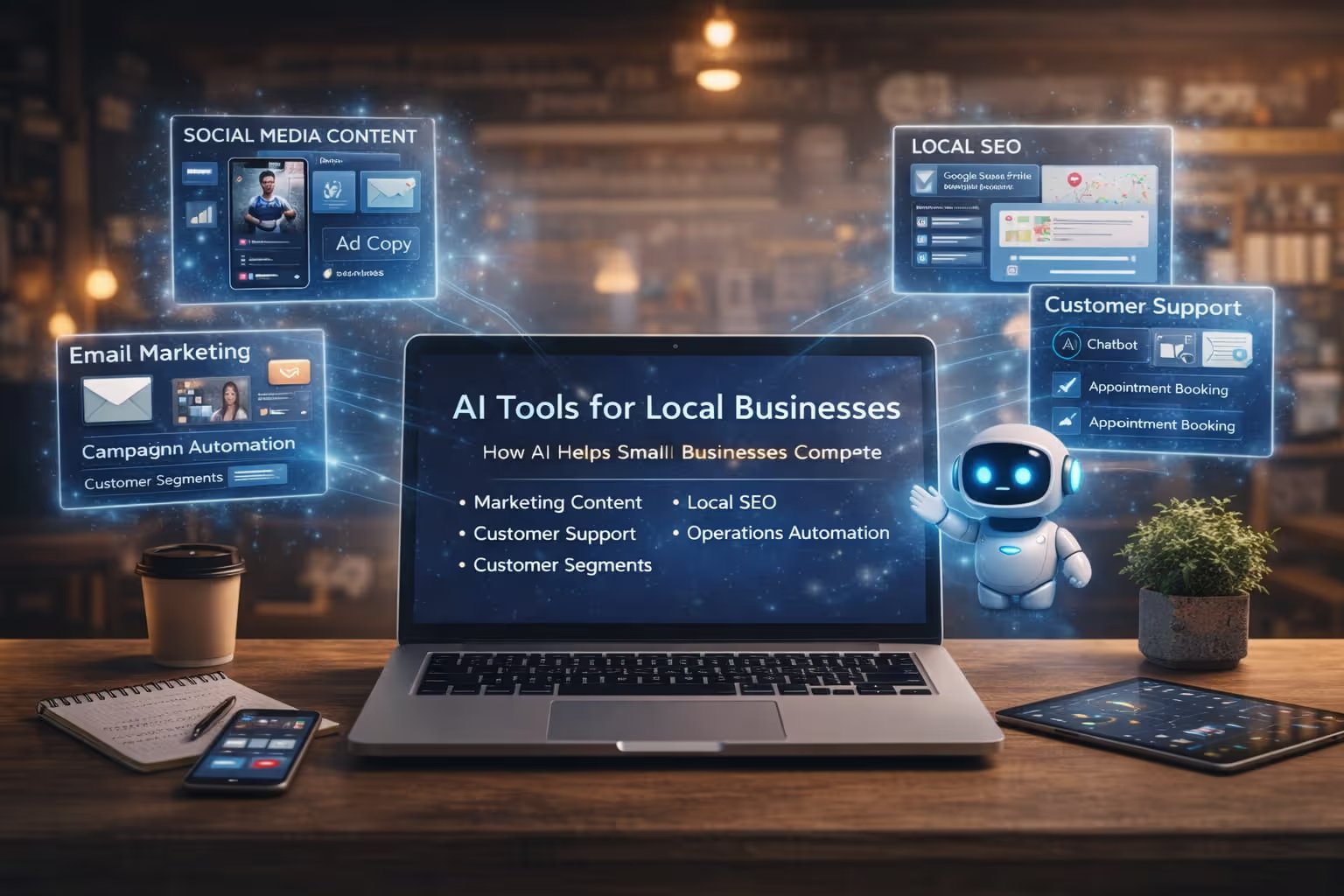
AI Tools for Local Businesses: Best Tools and Use Cases
For decades, local businesses have operated at a structural disadvantage. Large corporations had entire departments dedicated to marketing, customer service, and data analysis resources that a neighborhood restaurant or independent salon simply couldn't afford.
That gap is narrowing fast. Artificial intelligence is giving local business owners access to capabilities that were, until recently, reserved for companies with seven-figure budgets.
From generating social media content in seconds to answering customer questions at 2 AM, AI tools for local businesses are automating the repetitive, time-consuming tasks that used to eat up entire workdays.
The result: small business owners can focus on what they actually do well serving their community while AI handles the operational heavy lifting behind the scenes.
Why Local Businesses Are Adopting AI
Running a local business has never been more operationally demanding. A decade ago, marketing meant a Yellow Pages listing and maybe a Facebook page.
Today, competing effectively requires managing Google Business Profiles, producing short-form video, responding to reviews on multiple platforms, running email campaigns, maintaining a website, and staying visible in local search all simultaneously.
For most small business owners, that's simply not sustainable with a small team. According to a 2024 survey by the U.S. Chamber of Commerce, 98% of small businesses report that they are short on time, and marketing consistently ranks among the most time-consuming non-revenue activities they perform.
AI adoption among small businesses has accelerated as a direct response to this pressure. When a single tool can draft a week of social media captions, respond to customer inquiries, and flag which products are trending in the time it used to take to write one email the value proposition becomes impossible to ignore.
Local businesses aren't adopting AI because it's trendy. They're adopting it because they're stretched thin and AI actually works.
Ways Local Businesses Can Use AI
Marketing Content Creation
Content is the currency of modern marketing, and creating it consistently is one of the biggest challenges local businesses face. AI writing and design tools can now produce blog posts, social media captions, email newsletters, promotional copy, and even ad creatives in a fraction of the time it would take a human to do manually.
Tools like ChatGPT, Claude, Jasper, and Copy.ai can generate brand-consistent copy when given basic context about the business its tone, audience, and offer.
For visual content, tools like Canva's AI features and Adobe Firefly allow non-designers to produce professional-quality graphics, promotional flyers, and social assets without hiring a creative agency.
The most effective use of AI in content creation isn't to replace the business owner's voice it's to amplify it. Feeding the AI with specific details, local references, and customer language produces content that feels authentic rather than generic.
Customer Communication
One of the highest-impact applications of AI for local businesses is automating customer-facing communication. AI chatbots and virtual assistants can handle appointment booking, answer frequently asked questions, collect contact information, and even manage complaints all without requiring a staff member to be available.
Platforms like Tidio, Intercom, and Manychat integrate directly with websites and social media inboxes to provide instant responses 24/7. For a dental office that receives appointment requests at all hours, or a plumber who gets emergency calls on weekends, this kind of always-on responsiveness can directly translate to more booked jobs.
AI can also personalize follow-up communication. Automated email sequences triggered by customer behavior a lapsed client who hasn't visited in three months, or a new customer who just made their first purchase keep businesses top of mind without requiring manual outreach.
Local SEO Optimization
Showing up in Google's local results particularly in the "local pack" that appears on maps is one of the highest-value marketing outcomes for any brick-and-mortar business. AI tools are making local SEO more accessible to businesses that don't have a dedicated SEO team.
AI-powered tools can audit a Google Business Profile and identify missing information, suggest keyword-optimized business descriptions, generate responses to customer reviews, and recommend categories that improve local search visibility.
Tools like BrightLocal, Semrush's local SEO suite, and even ChatGPT with the right prompts can significantly streamline the local SEO workflow.
Beyond the Google Business Profile, AI can help identify the locally relevant keywords customers are actually searching for, flag technical issues on a business's website, and generate location-specific landing page content that helps rank for terms like "best electrician in [city]" or "hair salon near downtown [neighborhood]."
Business Operations
AI's value for local businesses extends well beyond marketing. On the operational side, tools are helping owners manage inventory, forecast demand, schedule staff, process accounting, and extract insights from sales data tasks that previously required either significant manual effort or expensive software.
Accounting tools like QuickBooks and FreshBooks now incorporate AI to automatically categorize transactions, flag unusual expenses, and generate financial summaries in plain language.
Scheduling tools like When I Work and Homebase use AI to optimize staff schedules based on historical traffic patterns. Even inventory management platforms are using predictive AI to tell a retailer when to reorder stock before it runs out.
For business owners who wear every hat, these operational automations are often where AI delivers the most immediate return not by improving customer-facing interactions, but by quietly eliminating hours of back-office work every week.
Best AI Tool Categories for Local Businesses
AI Marketing Tools
These tools help local businesses create, distribute, and optimize marketing content without a dedicated marketing team:
- ChatGPT / Claude General-purpose AI assistants ideal for drafting copy, brainstorming campaigns, and generating content briefs
- Jasper Marketing-focused AI writer with brand voice training and campaign templates
- Canva AI Design platform with AI-powered image generation, copy suggestions, and brand kit management
- Mailchimp Email marketing platform with AI-powered send-time optimization and content personalization
- Buffer / Hootsuite Social media management tools with AI caption generation and post scheduling
AI Customer Support Tools
These tools automate customer communication and improve response times across channels:
- Tidio AI chatbot for websites and e-commerce stores that handles live chat, FAQ responses, and lead capture
- Manychat Conversational AI for Instagram, Facebook Messenger, and WhatsApp
- Intercom Customer messaging platform with AI-assisted ticketing and chatbot automation
- Podium Messaging hub designed for local businesses that centralizes texts, reviews, and chat in one AI-assisted inbox
- Birdeye Review management and customer experience platform with AI-generated review responses
AI Analytics Tools
These tools help local businesses understand their data without needing a data analyst:
- Google Analytics 4 Website analytics with AI-powered anomaly detection and predictive metrics
- Looker Studio Free dashboard tool that connects to multiple data sources and supports AI-generated summaries
- Tableau Business intelligence platform with natural language query features for non-technical users
- Klaviyo E-commerce analytics and email tool with AI-driven segmentation and revenue attribution
- Metrilo Customer analytics for retail and e-commerce focused on retention and lifetime value
AI Productivity Tools
These tools reduce administrative overhead and help small teams accomplish more:
- Notion AI Note-taking and knowledge management with AI writing and summarization built in
- Otter.ai Automatic meeting transcription and summary generation
- Zapier No-code automation platform that connects apps and uses AI to build workflows
- QuickBooks Accounting software with AI-powered expense categorization and financial reporting
- Motion AI-powered calendar and task manager that automatically schedules work based on priorities and deadlines
Examples of AI Use Cases by Business Type
Restaurants
A local restaurant can use AI to generate weekly social media posts featuring daily specials, respond to Google and Yelp reviews automatically, optimize their menu descriptions for local search, and forecast busy periods based on historical reservation data.
AI chatbots can handle reservation inquiries and answer menu questions directly in a restaurant's Instagram DMs reducing the burden on front-of-house staff.
Hair Salons and Beauty Services
For salons, AI-powered booking tools eliminate the back-and-forth of scheduling. Automated reminder sequences reduce no-shows. AI can analyze which services are most profitable by stylist, flag clients who haven't returned in 90 days, and send personalized reactivation messages.
On the marketing side, AI tools can generate before-and-after caption ideas, suggest relevant trending hashtags, and even help plan a content calendar around seasonal promotions.
Local Service Providers (Plumbers, Electricians, HVAC)
Service businesses live and die by their local search visibility. AI can help these businesses maintain an optimized Google Business Profile, generate keyword-rich service-area landing pages, and automate review request campaigns after each completed job.
AI chatbots can capture leads from a website at any hour, qualify the inquiry, and notify the owner turning a 2 AM "emergency" website visit into a booked job.
Retail Stores
Independent retailers can use AI to manage inventory more intelligently predicting which products to restock before they sell out and flagging slow-moving items. AI-powered email tools can send personalized product recommendations based on past purchases.
Social content tools can generate product descriptions, promotional campaigns, and seasonal sale copy at scale, without the owner spending hours writing.
Real Estate Agents and Property Managers
Real estate professionals can use AI to generate property listing descriptions, draft follow-up emails to leads, summarize contracts, transcribe client calls, and manage their CRM more efficiently. Local SEO tools help agents rank for neighborhood-specific searches, which is often where buyers begin their journey.
How AI Tools Actually Help Small Businesses Scale
For many small businesses, adopting AI tools is not about chasing the latest technology trend. It's about finding practical solutions that help small business owners handle more tasks, improve efficiency, and boost productivity without hiring additional employees.
Modern AI tools for small businesses combine generative AI, machine learning, and intelligent systems that learn patterns from how a business operates. Instead of replacing people, these tools work more like an AI assistant that helps teams move faster and manage repetitive tasks that normally consume hours of manual work.
For example, many AI tools can now create marketing copy, generate images, draft videos, and produce new content for websites or social media. Others help answer common questions from customers through virtual assistants integrated into the web, messaging apps, or even a contact center.
When an AI tool integrates directly with existing apps like Google Workspace, it can automate workflows across multiple systems, making everyday tasks significantly faster.
This is where the real AI capabilities become valuable for small businesses. Modern AI models can analyze customer data, support sales teams, suggest marketing ideas, and help solve problems that previously required specialized expertise.
Some businesses are even experimenting with agentic AI, where multiple AI agents collaborate to manage workflows and complete complex tasks with minimal supervision.
The result is measurable improvements in efficiency, speed, and overall productivity. Instead of spending hours on administrative tasks, small business owners can focus on customer relationships and strategic decisions that help their business scale.
AI is also transforming the customer experience. Tools that improve customer service allow businesses to respond instantly to inquiries, automate appointment bookings, and support customers at any time of day. A small team can now deliver a level of responsiveness that previously required a full contact center operation.
Of course, adopting AI tools for small businesses still requires thoughtful implementation. Business owners must evaluate costs, ensure the tools actually improve efficiency, and choose platforms that make financial sense.
The goal is not to replace people, but to help employees and owners handle more work with fewer bottlenecks.
When used correctly, artificial intelligence helps small businesses reduce operational costs, increase sales, and operate with the kind of productivity that used to require much larger teams.
Instead of spending more money on additional staff, owners can pay for a few well-chosen AI tools that automate the right tasks and allow the business to grow without increasing overhead.
In practical terms, AI for small businesses works best when owners start small. Choose one or two tools that address a clear operational challenge, test how they fit with your existing systems, and gradually expand to other tools as the team becomes comfortable using the technology.
Businesses that adopt AI this way are more likely to see lasting improvements in efficiency, productivity, and long-term growth.
Benefits of AI for Small Businesses
Time savings. The most immediate and consistent benefit of AI adoption is time. Tasks that took hours writing a newsletter, responding to reviews, generating social content now take minutes. For a business owner already working 60-hour weeks, that reclaimed time has real value.
Cost efficiency. AI tools often replace the need to hire additional staff or outsource to agencies. A local business that would have paid an agency $2,000 a month for social media management can replicate much of that output with a $50/month AI writing tool and a few hours of guided effort.
Consistency and availability. AI doesn't take days off, get sick, or miss deadlines. Customer inquiries get answered immediately. Social posts go out on schedule. Review responses go up promptly. That consistency builds trust with both customers and search engines.
Competitive parity. AI levels the playing field in meaningful ways. A single-location boutique can produce marketing content that looks as polished as a national chain's. A two-person service business can have a customer communication system that rivals a company with a full support team.
Better decisions from data. AI analytics tools help business owners understand what's actually working which marketing channels drive revenue, which products have the best margins, which customer segments are most valuable. That clarity makes it easier to allocate resources effectively rather than guessing.
Common AI Mistakes Small Businesses Make
Using AI without a strategy. AI is a tool, not a plan. Generating content without a clear audience or goal produces output that looks busy but accomplishes nothing. Before adopting any AI tool, define what problem you're solving and how you'll measure success.
Over-relying on generic output. AI writing tools produce decent first drafts but generic, unedited output reads like generic, unedited output. Local businesses that publish AI content without adding their own voice, local references, and specific expertise produce content that fails to connect with their community.
Ignoring data quality. AI analytics tools are only as useful as the data they're analyzing. If a business's Google Analytics is misconfigured, its email list is outdated, or its sales data is inconsistent, AI won't fix those problems it will just surface them more efficiently.
Automating customer relationships too aggressively. There's a version of AI-powered customer communication that feels helpful and responsive, and a version that feels cold and robotic. Local businesses build loyalty through personal connection. AI should enhance that connection, not replace it entirely. Customers who can tell they're getting a form response especially after a complaint will go elsewhere.
Adopting too many tools at once. The AI tool landscape is overwhelming, and the temptation to try everything is real. Most local businesses benefit more from fully integrating one or two well-chosen tools than from dabbling with ten. Start with the highest-leverage problem usually content creation or customer communication and build from there.
Skipping the review step. AI tools can and do make mistakes factual errors, tone mismatches, or content that doesn't reflect a business's actual policies. Every piece of AI-generated content should be reviewed by a human before it goes out. The goal is to save time, not to remove judgment from the process.
AI is no longer a luxury reserved for companies with large technology budgets. The tools available today are affordable, accessible, and powerful enough to make a real difference for a local business competing in a crowded market. The businesses that will benefit most aren't those that adopt AI for its own sake they're the ones that identify their real operational bottlenecks, choose tools that address those specifically, and use AI to free up time for the work that only a human can do.