
Local Advertising for Your Business | Blaze.ai

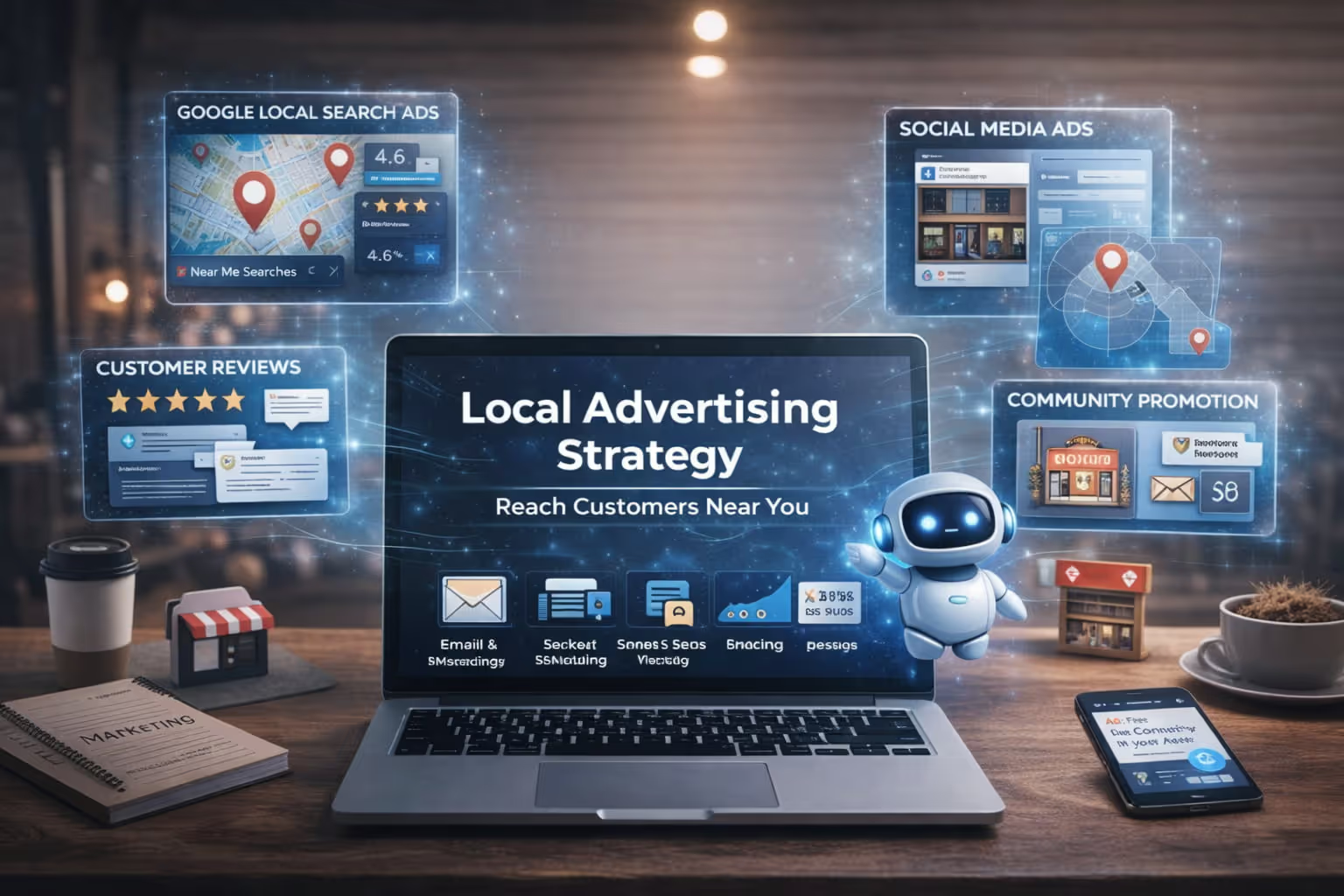
Local Advertising for Your Business: Strategies That Work
For most small and mid-sized businesses, the customers who matter most aren't scrolling through national campaigns; they're around the corner. Whether you run a dental practice, a home services company, or a neighborhood restaurant, your revenue depends on people nearby choosing you over the competitor down the street.
That's why local advertising isn't just a tactical add-on to your marketing plan; it's the foundation of sustainable growth. Done right, it builds the kind of brand recognition that turns first-time visitors into regulars and regulars into advocates who send their friends your way.
What Local Advertising Means
Local advertising refers to any marketing effort deliberately targeted at audiences within a specific geographic area: a neighborhood, city, zip code, or metro region.
Unlike broad national campaigns designed to generate mass awareness, local advertising is precision-driven. Its goal is to reach the people who are both geographically close enough to act and contextually ready to buy.
This targeting can take many forms: a Google Search ad that only shows to users within 10 miles of your location, a Facebook campaign geofenced to a single zip code, a sponsored post in a neighborhood Facebook group, or even a flyer distributed at the local farmers market.
What unifies all of these is intent: the message is crafted and delivered with a specific community in mind, not a faceless national audience.
Local advertising also operates on a different conversion logic than broad campaigns. Because the audience is physically close and often already in-market (searching for a service nearby, driving past your location, asking neighbors for recommendations), the path from ad exposure to action is significantly shorter.
This makes local campaigns highly measurable and often more cost-efficient than their national equivalents.
Why Local Marketing Matters
Consumer behavior has shifted dramatically in favor of local discovery. Searches including phrases like "near me" or "open now" have grown consistently year over year, and a substantial majority of those searches result in a store visit or purchase within 24 hours.
When someone searches for "emergency plumber near me" at 8 PM on a Tuesday, they aren't browsing; they're ready to call whoever shows up first and looks trustworthy.
Beyond search intent, there's something more durable at play: community trust. People prefer to spend money with businesses that feel like part of their world.
A local brand that sponsors the youth soccer league, runs ads in the neighborhood newsletter, or responds to Google reviews with a personal touch builds a kind of credibility that no national brand can replicate.
That trust compounds over time it shapes word-of-mouth referrals, drives repeat business, and insulates you when a larger competitor enters the market.
Local marketing also creates a feedback loop that national advertising can't offer. When your customer base is geographically concentrated, you can observe real-world results quickly: foot traffic changes, phone call volume, walk-in mentions of seeing your ad. This visibility makes it easier to iterate, optimize, and double down on what works.
Best Local Advertising Channels
Google and Local Search
Google remains the most powerful local advertising platform available to small businesses, and for good reason it captures people at the highest point of intent. There are two primary levers to pull here: Google Business Profile (formerly Google My Business) and Google Local Search Ads.
Your Google Business Profile is non-negotiable. It controls what appears when someone searches your business name or your category in your area. A complete, well-maintained profile with accurate hours, recent photos, a strong review count, and responses to reviews directly improves your visibility in the local pack
(the map-based results that appear above organic listings). This is free, and it's often the highest-ROI local marketing activity a business can undertake.
Google Local Search Ads amplify this with paid placement. Local Services Ads (LSAs), available for service-based businesses, display above standard search results with a "Google Guaranteed" badge, charging you per lead rather than per click, a significant advantage for managing acquisition costs.
Standard Google Ads with location targeting allow for more creative control and work well for businesses promoting specific offers or services to a tightly defined radius.
Social Media Ads
Social platforms primarily Facebook and Instagram offer unmatched geographic and demographic precision for local advertisers. You can target users within a specific radius of your business, layer on demographic filters like age or household income, and even retarget people who have visited your website or engaged with your posts.
For local businesses, the most effective social media ad formats tend to be simple and conversion-focused: a strong offer, a compelling visual, a clear call to action, and tight geographic targeting.
Carousel ads work well for showcasing multiple products or services, while video ads, even short, low-production ones filmed on a smartphone, consistently outperform static images in engagement.
Don't underestimate organic community presence alongside paid ads. Active participation in local Facebook Groups, neighborhood apps like Nextdoor, and Instagram location tags builds brand familiarity that makes your paid ads work harder when they reach the same people.
Email and SMS Marketing
Email and SMS marketing are among the highest-ROI channels available to local businesses precisely because they target people who have already opted in customers who have bought from you before, signed up for your newsletter, or joined your loyalty program. These aren't cold leads; they're warm audiences who already know your name.
For local campaigns, email works well for seasonal promotions, event announcements, and loyalty rewards. Keep the copy concise, lead with value, and include a single clear call to action. Personalization, even as simple as using the recipient's first name or referencing their last purchase, meaningfully improves open and click rates.
SMS is faster and more immediate. Open rates for text messages far exceed email, making it the right channel for time-sensitive offers: "Flash sale today only," "Your appointment is tomorrow," or "We're at the farmers market this weekend come say hi."
The key is restraint. Customers tolerate frequent emails but are quick to opt out of SMS lists that feel intrusive, so reserve texts for genuinely high-value messages.
Community Advertising
Some of the most effective local advertising doesn't happen on a screen at all. Sponsoring local events, a youth sports team, a charity 5K, a neighborhood block party puts your brand in front of the community in a context of goodwill.
Print ads in local publications, partnership promotions with complementary businesses, and even well-placed physical signage continue to drive awareness and traffic in ways that digital campaigns can miss.
Community advertising is particularly powerful for building the kind of ambient brand recognition that primes people to choose you when they eventually do search online.
When someone sees your name at the school fundraiser, hears it from their neighbor, and then spots your Google ad the combination creates a sense of familiarity that no single channel achieves alone.
Budget-Friendly Local Advertising Ideas
Effective local advertising doesn't require a large budget, it requires focus. Here are actionable strategies that deliver results without overspending.
Claim and fully optimize your Google Business Profile. This is free, and most businesses leave it incomplete. Add every relevant category, upload fresh photos monthly, answer every question, and respond to every review. This alone can meaningfully improve local search visibility.
Run hyperlocal social ads with a small daily budget. Facebook and Instagram allow campaigns starting at just a few dollars per day. A tightly targeted offer, a discount, a free consultation, a seasonal promotion aimed at users within 5 miles can generate real leads without requiring a large media spend.
Build a referral program. Word-of-mouth is the original local advertising. A simple incentive, a discount on the next visit, a gift card, a free service upgrade for customers who refer friends costs almost nothing and produces highly qualified leads who arrive pre-sold.
Partner with complementary local businesses. A gym and a nutrition store. A real estate agent and a moving company. A dentist and an orthodontist. Cross-promotional partnerships, shared email blasts, co-branded social posts, referral arrangements let both parties reach each other's audiences at zero media cost.
Create locally relevant content. A blog post about the best parks in your city, a social media series featuring local events, or a guide to navigating your neighborhood builds organic search visibility and signals community investment to potential customers.
Content that targets local keywords ("best HVAC service in [city]") is also dramatically less competitive than broad national terms.
Ask for reviews systematically. Online reviews function as perpetual local advertising. A well-timed follow-up text or email asking satisfied customers to leave a Google review, repeated consistently, compounds into a review profile that influences new customers for years.
Using AI to Improve Local Advertising
Artificial intelligence has moved from a novelty to a practical tool for local advertisers, and businesses that adopt it early are gaining a meaningful operational edge.
The most immediate application is ad copy generation. AI tools can produce multiple variations of headlines, body copy, and calls to action for a given offer in seconds allowing small teams to test different messages across channels without dedicating hours to copywriting.
Feeding the AI specific inputs (target audience, key offer, tone, geographic context) sharpens the output considerably.
AI is equally useful for campaign ideation. Describe your business, your seasonal calendar, your best-performing past promotions, and your target customer to an AI assistant, and it can suggest campaign concepts, channel mixes, and promotional angles you may not have considered.
This is especially valuable for solo business owners or small teams who don't have a dedicated marketing strategist.
For email and SMS marketing, AI can personalize content at scale generating message variations based on customer segments, purchase history, or engagement patterns. What once required marketing automation expertise can now be approximated by a business owner with a basic prompt and a capable AI tool.
AI-powered analytics tools can also help local businesses interpret performance data identifying which ads are driving calls, which audiences are converting, and where budget is being wasted without requiring deep expertise in ad platforms. The result is faster learning and better allocation of limited budgets.
How to Build a Local Advertising Strategy That Actually Drives Customers
Start with Visibility in Search Engines
When people look for a service nearby, they usually start with search engines. Whether someone is searching for a restaurant, a dentist, or a plumber, local searches often lead directly to action. This is why local SEO is one of the most important foundations of any business locally.
Optimizing your presence for search engines helps your business appear in search results when nearby customers are ready to act. A strong local SEO setup ensures your business information, business hours, service area, and services offered are easy for both mobile users and search platforms to understand.
To improve organic rankings, make sure your website includes clear landing pages that describe each service and location you cover. These landing pages should also highlight your value proposition, helping potential customers understand why your business locally is the right choice.
Creating unique landing pages for each service or location can dramatically improve organic rankings, generate more traffic, and increase user clicks from search results.
List Your Business in Key Directories
Another effective step is ensuring your business appears in online directories and free online directories where people search for local services.
Listings in places like Apple Maps, free online directories, and other online directories reinforce your local SEO signals while helping nearby customers find your website and contact you through a direct line.
These listings also strengthen your presence across search engines, increasing the chances your business appears in local searches when customers are comparing options.
Use Social Media to Reach the Local Audience
While search engines capture high-intent demand, social media helps build awareness and familiarity within your local community.
Posting consistently on social media platforms helps businesses connect with a local audience before they even begin searching. Effective social media posts can showcase promotions, highlight happy customers, and demonstrate real experiences with real customers.
Encouraging user generated content is particularly powerful. When customers share photos, reviews, or stories about your business, that user generated content builds credibility with other nearby customers. Over time, this type of user generated content becomes a form of word-of-mouth advertising inside the local community.
Sharing user generated content regularly on social media platforms also increases engagement and helps businesses build relationships with customers in a natural way.
Leverage the Local Community
Not all effective advertising ideas happen online. Partnerships with business associations, industry specific associations, and community groups can dramatically increase trust.
Sponsoring events covered in local news, collaborating with other businesses locally, or participating in local community events helps small businesses connect with a local community that already supports nearby brands.
For small businesses, visibility in the local community often matters more than national reach. Even simple efforts, like sharing updates with business associations or appearing in local news, can increase recognition and bring in more customers.
Turn Your Website Into a Conversion Engine
Once potential customers discover you, your website must make it easy for them to act.
Your website should be mobile friendly, clearly present your services offered, and include multiple landing pages designed to convert visitors into customers. Each of these landing pages should reinforce your value proposition, provide clear contact options, and guide visitors toward the next step.
For example, landing pages can include appointment forms, phone numbers, or a qr code linking directly to a booking page. A simple qr code placed in local ads or printed materials can also send offline visitors directly to your landing pages.
Build Trust Through Reviews and Real Experiences
In local markets, reputation travels fast. Reviews, testimonials, and user generated content help businesses demonstrate trust to nearby customers.
Encouraging happy customers to share their experiences creates valuable user generated content that reinforces credibility across social media, directories, and search engines.
These reviews influence search results, improve organic rankings, and reassure new customers that your business locally delivers real value.
Align Local Advertising with Your Marketing Goals
The most effective local advertising strategy connects all these elements to clear marketing goals.
Whether the objective is generating more phone calls, increasing foot traffic, or attracting nearby customers online, every tactic should support the same outcome: bringing more customers to your business locally.
Achieving that doesn't always require a large budget. Often it only requires little creativity, consistency, and a clear focus on reaching the right local audience.
By combining local SEO, social media, directory listings, and community partnerships, small businesses can create a system that consistently attracts nearby customers and builds lasting relationships within the local community.
Common Local Advertising Mistakes
Even well-intentioned local campaigns frequently stumble on the same avoidable errors.
Targeting too broadly. A local business running ads without geographic constraints is paying to reach people who will never set foot in their location. Always set tight location parameters and revisit them regularly, as platform defaults don't always match your intentions.
Ignoring the Google Business Profile. Many businesses run paid ads while their free profile sits unclaimed or outdated. A potential customer who sees your ad and then finds a profile with wrong hours, no photos, and unanswered negative reviews is unlikely to convert. The profile is often the last thing they check before calling treat it accordingly.
Leading with features instead of benefits. "We've been in business for 25 years" tells the customer about you. "We fix your HVAC the same day you call guaranteed" tells them what's in it for them. Local audiences are skeptical and time-pressed; lead with the outcome, not the credential.
Setting and forgetting campaigns. Launching an ad and leaving it untouched is a reliable way to waste budget. Click-through rates decay, audiences develop ad fatigue, and seasonal relevance shifts. Build a habit of reviewing performance weekly and refreshing creative monthly, even if the changes are modest.
Neglecting reviews and reputation. Running ads while ignoring your online reputation is like inviting guests to a house you haven't cleaned. Negative reviews that go unaddressed, or a low star rating relative to competitors, will suppress conversion rates no matter how well-crafted your ads are.
Review management isn't optional it's a core part of the local advertising system.
Spreading budget across too many channels too soon. It's tempting to be everywhere at once, but a small budget divided five ways produces weak results on all five fronts. Start with the one or two channels most likely to reach your specific audience, prove what works, then expand.
Concentration beats distribution at the local level.