
Financial Analysts Using AI: How to Stay Relevant and Work Smarter

Financial Analysts Using AI: How to Stay Relevant and Work Smarter
The finance industry is undergoing one of its most significant transformations in decades and artificial intelligence is at the center of it. From automating data-heavy workflows to generating real-time forecasts, AI tools are reshaping how financial analysts work at every level.
For many professionals, that change triggers an understandable anxiety: will my role still exist in five years?
The short answer is yes, but only for analysts who adapt. This guide is not a warning. It is a practical roadmap. AI is not the end of the financial analyst; it is the beginning of a more powerful version of the role.
The analysts who learn to work alongside AI tools will move faster, cover more ground, and deliver sharper insights than those who do not. The ones who ignore the shift will find themselves competing with peers who have already moved on without them.
What Does It Mean for Financial Analysts to Use AI?
Before diving into tools and tactics, it helps to understand what AI adoption actually looks like in practice, because it is less about dramatic disruption and more about a gradual but meaningful shift in how analysts spend their time.
From Manual to AI-Driven Financial Work
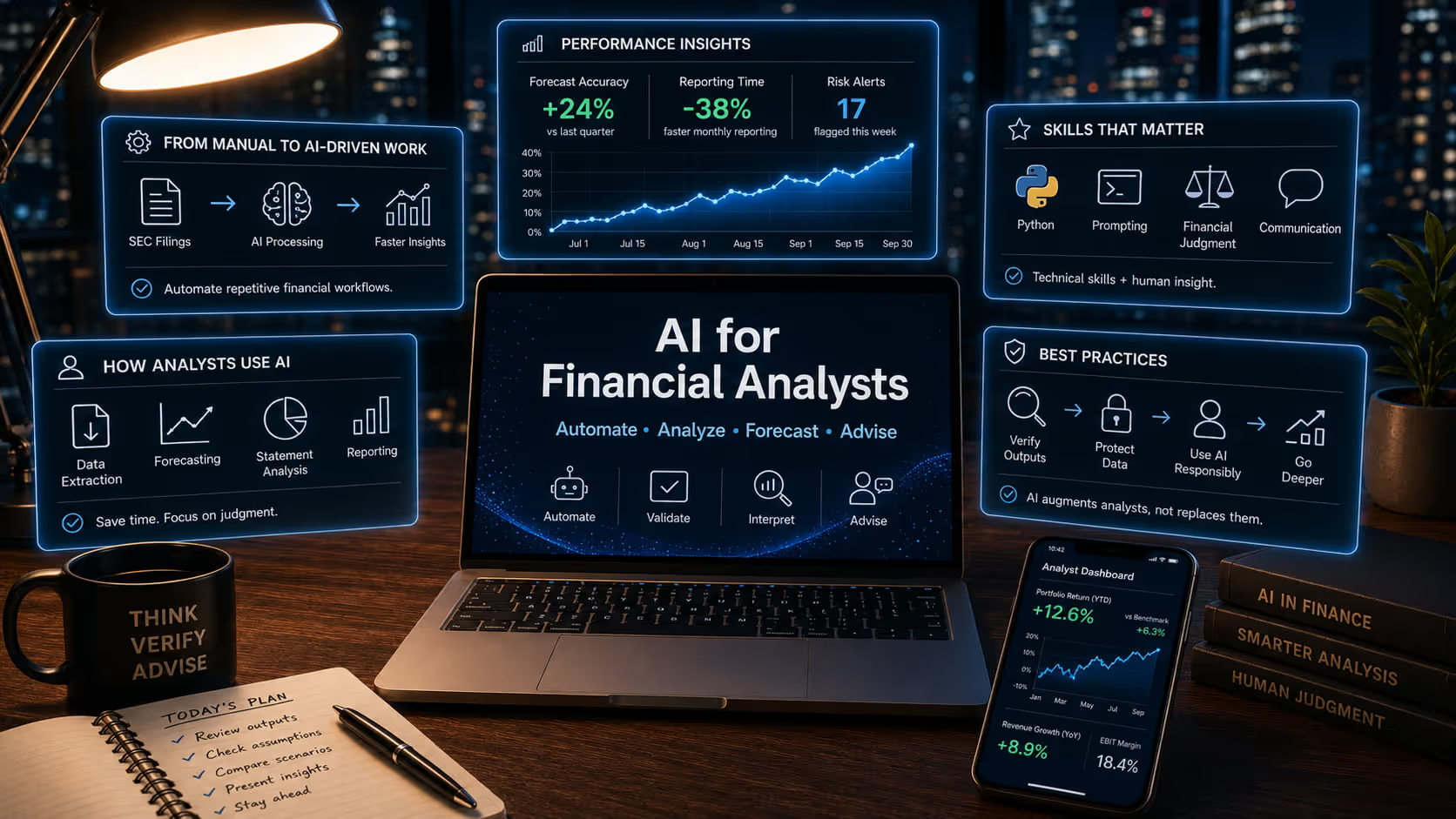
Most analysts today still rely on a familiar stack: Excel models built from scratch, hours spent pulling data from earnings reports and SEC filings, manual reconciliations, and slide decks assembled by hand. The work is rigorous, but a significant portion of it is repetitive and time-consuming by nature.
AI automates the most labor-intensive layers of that work. It can pull structured data from documents, clean and organize it, flag anomalies, run pattern recognition across large datasets, and generate first-draft reports, all in the time it would take an analyst to open a spreadsheet.
What this means in practice is that the analyst role is shifting from execution to oversight. Rather than building every model from the ground up, analysts are increasingly reviewing, validating, and interpreting outputs that AI has already produced. The cognitive load shifts from data wrangling to critical thinking.
AI as Augmentation, Not Replacement
The distinction that matters most is the one between pattern recognition and judgment. AI is exceptionally good at the former. Feed it enough historical data, and it will find correlations, trends, and anomalies faster than any human team could.
But it cannot tell you whether a CEO is being evasive on an earnings call, whether a set of assumptions reflects the real strategic direction of a business, or how to present a difficult forecast to a skeptical board.
That judgment, shaped by experience, context, and relationship, remains entirely human. Think of AI less as a replacement and more as a tireless junior analyst who never sleeps, never gets bored, and can process ten times the data you can. Your job is to direct it, check its work, and make the calls that actually matter.
How Financial Analysts Are Using AI Right Now
Across buy-side and sell-side roles, in FP&A teams and risk departments, analysts are already putting AI to work in concrete, measurable ways. Here is what that looks like on the ground.
Automating Data Collection and Processing
One of the most immediate applications is data gathering. AI tools can now extract structured financial data from earnings reports, 10-Ks, and SEC filings in minutes rather than hours.
Natural language processing models can parse earnings call transcripts, flag sentiment shifts, identify forward-looking statements, and summarize key guidance, tasks that would previously require an analyst to read every word carefully.
What used to take a full workday can now take twenty minutes. That time does not disappear; it gets redirected to the analysis itself.
AI-Powered Financial Modeling and Forecasting
Machine learning models excel at identifying patterns in historical financial data that traditional regression-based models often miss. For financial modeling, this means more nuanced revenue forecasts, better sensitivity analysis, and the ability to update assumptions in real time as new data arrives.
In FP&A specifically, AI is being used to run scenario planning and stress testing at a scale that was previously impractical. Rather than building three scenarios by hand, teams can generate dozens of permutations, understand the distribution of outcomes, and present leadership with a much richer picture of what the future might look like.
Financial Statement Analysis at Scale
Traditionally, a thorough financial statement analysis covers one company at a time. AI removes that constraint. Analysts can now run comparative analysis across entire sectors simultaneously, flagging anomalies in margin trends, working capital movements, or revenue recognition patterns across dozens of companies in a single pass.
For due diligence in M&A or investment research, this is a significant advantage. The initial screening process, which used to eliminate most of an analyst's time before any real judgment could be applied, can now be compressed dramatically, leaving more room for the deeper qualitative work that actually drives decisions.
Automating Routine Reporting Workflows
Variance reports, monthly reconciliations, budget-versus-actual summaries, these are necessary deliverables that consume a disproportionate amount of analyst time relative to their complexity.
AI tools can now generate first drafts of these reports automatically, pulling from the relevant data sources and formatting outputs according to predefined templates.
The analyst's role becomes editing and refining rather than building from scratch. For month-end close cycles in particular, this represents a meaningful reduction in the time pressure that defines the end of every reporting period.
Risk Assessment and Compliance Monitoring
AI is increasingly used for real-time portfolio monitoring, flagging positions that breach risk thresholds or exhibit unusual behavior before a human reviewer would catch it.
On the compliance side, machine learning models can run regulatory stress tests continuously rather than periodically, and they can scan transaction data for patterns associated with reporting anomalies or control failures.
The human error rate in manual compliance work is not zero. AI does not eliminate risk, but it reduces the probability that something important slips through because someone was tired or distracted on a Friday afternoon.
Will AI Replace Financial Analysts?
This is the question most analysts are quietly asking, and it deserves a direct answer rather than a deflection.
What AI Can and Cannot Do
AI performs exceptionally well on structured, rule-based tasks with clear inputs and outputs. Data extraction, pattern matching, report generation, and scenario modeling all fall into this category. These are real parts of the analyst job, and AI will handle more of them over time.
What AI cannot do is replicate the judgment that comes from years of industry experience, the relationship intelligence that comes from knowing how a management team operates under pressure, or the communication skills required to translate a complex financial analysis into a recommendation that a non-technical audience can act on.
These are not soft skills in the dismissive sense of that phrase, they are the hardest skills to develop and the least substitutable.
The high-value work, the analysis that actually influences decisions, remains human-led. What changes is the amount of preparatory work required to get there.
How the Role Is Evolving
The evidence is already clear: analysts who use AI tools outperform those who do not, not because they are smarter but because they can cover more ground, iterate faster, and spend more time on the parts of the job that matter most.
New archetypes are emerging. The analyst who can write a Python script to automate a data pipeline and then interpret the output with genuine financial acumen is more valuable than one who can only do the latter.
The analyst who understands how to evaluate an AI-generated model, knowing where to push back and where to trust it is more valuable than one who either accepts outputs uncritically or refuses to use them at all.
The real career risk is not AI adoption. It is resistance to it.
Skills Financial Analysts Need to Work With AI
Knowing that adaptation is necessary is one thing. Knowing where to start is another.
Technical Skills to Build
Python is the most practical starting point for most analysts. You do not need to become a software engineer, but familiarity with pandas and NumPy for data manipulation, combined with the ability to call financial data APIs, will unlock a significant range of AI-assisted workflows.
The learning curve is steeper than Excel but more manageable than most analysts expect.
Prompt engineering, the ability to write clear, structured instructions for large language models, is already a meaningful differentiator. Understanding how to frame a financial analysis task for an AI tool, how to check its outputs, and how to iterate on results is a skill that will only become more valuable.
A conceptual understanding of machine learning, what different model types are suited for, how they can fail, and how to evaluate their outputs is increasingly useful even for analysts who will never build a model themselves.
Domain and Soft Skills That Still Win
Deep financial expertise is not less valuable in an AI-augmented environment, it is more valuable, because it is what allows you to evaluate whether an AI output is actually correct.
An analyst who does not understand what a plausible EBITDA margin looks like for a specific industry will not catch a flawed model output. One who does will.
Critical evaluation of AI outputs is itself a skill. It requires both financial knowledge and intellectual skepticism, the discipline to treat every AI-generated figure as a hypothesis to be tested rather than a fact to be accepted.
Stakeholder communication becomes more important, not less, as the analytical work becomes faster and more automated. The ability to distill a complex analysis into a clear recommendation and defend it under pressure is not something AI can replicate.
How to Get Started
For analysts who want a structured starting point, Coursera's Financial Analyst AI certificate program is a well-regarded option that covers both technical and applied skills.
Beyond formal coursework, the most effective approach is to pick two or three AI tools relevant to your specific role, whether that is a modeling assistant, a document analysis tool, or a data processing platform and go deep on them rather than experimenting broadly without follow-through.
The best learning happens on real tasks. Identify a workflow in your current role that is time-consuming and repetitive, and make it your test case. The results will be imperfect at first. That is fine. The iteration is how you build genuine fluency.
Best Practices for Financial Analysts Using AI
Getting value from AI requires more than adopting the tools. It requires using them responsibly.
Always Verify Outputs Against Source Data
AI systems produce plausible-sounding outputs. They also make mistakes, sometimes subtle ones that are easy to miss if you are not looking carefully. Treat every AI-generated figure as a first draft, not a final deliverable.
Cross-reference against source documents, check the math, and understand the assumptions before anything goes into a client-facing product or internal decision.
The analyst who sends an AI-generated report without reviewing it is not working smarter, they are creating liability.
Protect Confidential Financial Data
Before inputting any client or proprietary data into an AI tool, understand your firm's data handling policies. Many consumer-grade AI platforms store and use inputs for model training, which creates obvious confidentiality risks in a financial context.
Use enterprise-grade platforms with appropriate data agreements, and when in doubt, ask your compliance team before proceeding.
Use AI to Go Deeper, Not Cut Corners
The most significant long-term risk of AI adoption for individual analysts is skill erosion. If you stop building models because AI builds them for you, you will eventually lose the ability to evaluate whether the models are any good.
The goal is to use AI to cover more ground and go deeper on the analysis that matters, not to reduce the thinking required.
The analysts who benefit most from AI tools are the ones who use them to work harder on the right problems, not the ones who use them to work less.
Frequently Asked Questions
Are financial analysts being taken over by AI?
The short answer is no, at least not in the way the question implies. The role is changing, but it is not disappearing. Tasks that are purely data-driven and repetitive will increasingly be handled by AI, but the analytical judgment, stakeholder communication, and strategic thinking that define the most valuable analyst work remain outside what current AI systems can reliably do.
The analysts who will feel most displaced are those who have built their entire value proposition around tasks that AI does better and who have not developed adjacent skills. Avoidance is the real risk here, not adoption.
How can financial analysts use AI effectively?
Start with low-stakes tasks where the cost of an error is limited, a draft report, an internal model, a research summary. Build familiarity with how a specific tool behaves before relying on it for anything client-facing or decision-critical.
Once you have a baseline, look for ways to integrate AI into your modeling workflows: data ingestion, scenario generation, variance analysis.
The segment of the market you work in also matters. Buy-side analysts will find different tools more relevant than FP&A professionals or credit analysts. Identify what is most applicable to your specific context and invest there first.
What is the 30% rule for AI in finance?
The 30% rule refers to the widely cited estimate that AI is currently capable of automating roughly 30% of the tasks that make up the average financial analyst's workload. Importantly, that 30% is concentrated in the most repetitive, time-intensive parts of the job: data collection, formatting, routine reporting, and basic modeling.
This is not a threat, it is a productivity opportunity. If 30% of your time is freed up from tasks that required effort but not judgment, that is 30% that can be redirected toward the work that actually differentiates your output. Analysts who see it that way will capture the upside. Those who resist the change will simply fall behind peers who did not.
The Path Forward
The financial analysts who will thrive over the next decade are not necessarily the ones with the deepest Excel skills or the longest hours. They are the ones who adopt AI tools before their peers do, stay sharp on the high-value work that AI cannot replicate, and position themselves as the analysts that firms cannot afford to lose.
That combination, technical adaptability, genuine financial expertise, and the judgment to know the difference between what a machine can do and what requires a human, is what the market will reward. The shift is already underway. The question is not whether to engage with it, but how quickly you choose to start.