
AI Tools for Manufacturing Automation: A Practical Guide | Blaze

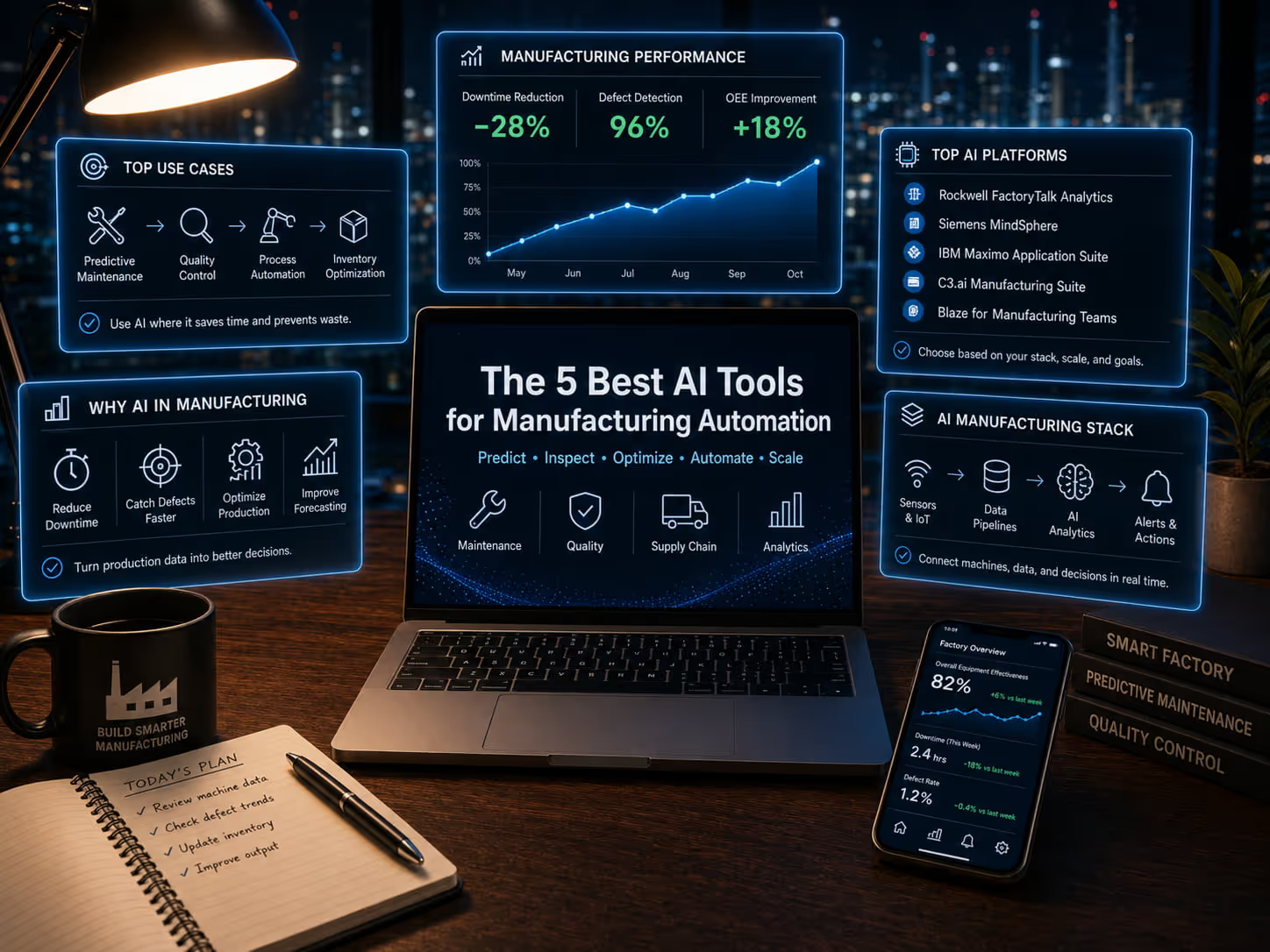
The 5 Best AI Tools for Manufacturing Automation
AI is changing the way factories operate, from predicting equipment failures to automating quality checks on the production line. Manufacturers that adopt the right AI tools are seeing faster output, lower costs, and fewer unplanned shutdowns.
This guide covers the top AI tools for manufacturing automation, what they do, and how to choose the right one for your operation.
What Are AI Tools for Manufacturing Automation?
Before diving into the tools themselves, it helps to understand what we mean by AI in a manufacturing context and why it represents such a significant leap beyond what traditional automation could offer.
How AI Fits Into Modern Manufacturing
Modern manufacturing generates enormous amounts of data every second, and AI exists to make sense of it. Machine learning algorithms detect patterns in production data that no human analyst could spot manually.
Computer vision systems inspect products at speed and scale that far exceed human visual inspection. Natural language processing allows operators to query systems using plain language and receive actionable insights in return.
Underlying all of this is real-time data processing, which allows AI systems to make decisions at the pace of the production line rather than after the fact. The result is decision-making at scale, where thousands of micro-optimizations happen continuously across an entire facility without requiring constant human input.
Difference Between Traditional Automation and AI Automation
Traditional automation operates on fixed rules. A conveyor belt runs at a set speed. A robot arm repeats the same motion. A sensor triggers the same alert every time a threshold is crossed. These rule-based systems are reliable but rigid. They cannot adapt when conditions change, and they cannot improve on their own.
AI automation works differently. Instead of following static scripts, AI systems learn continuously from new data. They adapt to changing conditions, recognize emerging problems before they become failures, and improve their own performance over time.
A traditional system will flag a vibration anomaly only if it crosses a preset threshold. An AI system learns what normal vibration looks like for a specific machine under specific load conditions and flags deviations that a fixed rule would never catch.
Key Components of an AI Manufacturing Platform
A complete AI manufacturing platform typically brings together three layers. The first is sensors and IoT integration, the hardware that collects real-world data from machines, production lines, and environmental conditions.
The second is data pipelines and analytics, the infrastructure that ingests, cleans, stores, and analyzes that data at scale. The third is software and control systems, the interfaces and decision engines that translate analysis into actions, alerts, and recommendations that operators and engineers can act on.
Top Use Cases for AI in Manufacturing
AI is not a single solution but a family of capabilities that apply across many different manufacturing challenges. Here are the areas where manufacturers are seeing the greatest impact.
Predictive Maintenance
Equipment failure is one of the most expensive events in any manufacturing operation. Predictive maintenance uses AI to monitor machine health continuously, analyzing data from vibration sensors, temperature gauges, acoustic monitors, and other sources to identify signs of wear or stress before they result in a breakdown.
Rather than relying on fixed maintenance schedules that may be too early or too late, AI-powered predictive maintenance allows teams to schedule repairs proactively, at the optimal moment, reducing both unplanned downtime and unnecessary maintenance costs.
Quality Control and Defect Detection
Maintaining consistent product quality at high production volumes is a persistent challenge. AI-powered vision systems placed on production lines can inspect every unit in real time, identifying surface defects, dimensional deviations, assembly errors, and other issues that human inspectors would struggle to catch consistently at speed.
These tools quickly identify defects that might otherwise make it downstream, reducing waste, rework, and the risk of defective products reaching customers.
Process Automation and Smart Manufacturing
Beyond individual machines, AI is being applied to entire production workflows. Digital manufacturing environments connect machines, systems, and people into a unified data ecosystem.
Within that ecosystem, AI monitors ongoing production processes continuously, detecting inefficiencies and bottlenecks as they develop and recommending or automatically implementing adjustments to optimize performance.
The outcome is a production floor that improves itself over time rather than simply executing the same process on repeat.
Supply Chain and Inventory Optimization
Manufacturing does not begin or end on the production floor. AI tools are being applied upstream and downstream to improve supply chain performance. Demand forecasting models analyze historical data, market signals, and external factors to predict what will be needed and when.
Automated reorder triggers ensure materials arrive before shortages develop. And smarter inventory management reduces holding costs by keeping stock levels aligned with actual production needs rather than conservative safety buffers.
Best AI Tools for Manufacturing Automation
The following tools represent some of the most capable and widely adopted AI platforms available to manufacturers today. Each brings different strengths, and the right choice depends on the size of your operation, your existing technology stack, and the specific problems you are trying to solve.
Rockwell Automation FactoryTalk Analytics
Rockwell Automation's FactoryTalk Analytics is a comprehensive industrial analytics platform built to help manufacturers extract actionable insights from their operational data.
It integrates with Rockwell's broader ecosystem of industrial hardware and software and is designed to support everything from real-time monitoring to predictive analytics and performance benchmarking.
Who it's best for: Mid-to-large manufacturers already operating within the Rockwell Automation ecosystem who want to add advanced analytics and AI capabilities without significant infrastructure changes.
Pricing: Pricing is not publicly listed and varies based on deployment size and configuration. Prospective buyers should contact Rockwell directly for a quote.
Pros and Cons: On the positive side, FactoryTalk Analytics offers deep integration with Rockwell hardware, strong real-time monitoring capabilities, and a well-established support network.
On the downside, organizations outside the Rockwell ecosystem may face a steeper integration challenge, and the platform's complexity can require significant implementation resources.
Siemens MindSphere
MindSphere is Siemens' industrial IoT and AI platform, designed to connect machines and physical infrastructure to the digital world. It provides tools for data collection, visualization, analytics, and application development, and it supports a wide range of industrial use cases across manufacturing, energy, and infrastructure.
Who it's best for: Large manufacturers and enterprises looking for a scalable, cloud-based industrial IoT platform with strong data integration capabilities and a broad partner ecosystem.
Pricing: MindSphere operates on a subscription model with pricing tied to the number of connected assets and the applications deployed. Siemens offers tiered plans, but specific pricing requires direct engagement with their sales team.
Pros and Cons: MindSphere's strengths include its scalability, extensive partner ecosystem, and broad industry applicability. However, smaller manufacturers may find the platform overwhelming in scope, and implementation typically requires significant technical resources or partner support.
IBM Maximo Application Suite
IBM Maximo Application Suite is an enterprise asset management platform with deep AI capabilities powered by IBM Watson. It is designed to help organizations manage physical assets across their entire lifecycle, with particular strength in predictive maintenance, reliability engineering, and visual inspection.
Who it's best for: Asset-intensive industries including heavy manufacturing, utilities, and transportation that need enterprise-grade asset management combined with AI-powered maintenance and inspection capabilities.
Pricing: Maximo Application Suite is priced on an AppPoints model, a consumption-based licensing approach that provides access to the full suite. Pricing is based on usage and scale and requires direct inquiry with IBM.
Pros and Cons: Maximo is one of the most mature and feature-rich platforms in this space, with strong AI capabilities and a long track record in enterprise environments. The trade-offs are complexity and cost. Implementation projects are often lengthy and resource-intensive, and the platform may be more than smaller manufacturers need.
C3.ai Manufacturing Suite
C3.ai is an enterprise AI software company offering a purpose-built suite for manufacturing that addresses predictive maintenance, supply chain optimization, energy management, and production optimization. The platform is model-driven and designed to accelerate AI deployment across large, complex organizations.
Who it's best for: Large enterprises and manufacturers with significant data infrastructure who want to deploy AI applications at scale across multiple use cases without building models from scratch.
Pricing: C3.ai does not publish pricing publicly. The company works with enterprise clients on custom contracts, and pricing is tied to deployment scale and the applications selected.
Pros and Cons: C3.ai's strengths lie in its breadth of pre-built AI applications, its enterprise scalability, and its ability to integrate with existing data systems. The platform is less suited to smaller manufacturers given its enterprise focus and pricing, and some organizations report a significant investment of time required to realize full value.
Blaze for Manufacturing Teams
Blaze is an AI-powered platform built to help manufacturing teams automate content creation, communications, and marketing workflows. While most of the tools on this list focus on production-floor AI, Blaze addresses a different but equally important challenge: how manufacturing companies market themselves, communicate with customers, and scale their content operations without adding headcount.
Who it's best for: Manufacturing companies and marketing teams within manufacturing organizations that need to produce consistent, high-quality content at scale, from product documentation and case studies to email campaigns and social media.
Pricing: Blaze offers a free trial, with paid plans available for teams that need advanced features and higher usage volumes.
Pros and Cons: Blaze is purpose-built for content and communications, making it fast to deploy and easy to use without technical expertise. It will not replace a production-floor AI platform, but for manufacturers looking to strengthen their marketing and communications output, it delivers clear and immediate value.
Final Thoughts on AI Tools for Manufacturing Automation
AI is no longer a future consideration for manufacturers. It is a present competitive advantage. The tools covered in this guide address some of the most pressing challenges in modern manufacturing, from unplanned downtime and quality failures to supply chain inefficiency and process optimization.
The right tool depends on your operation's size, complexity, and where you are experiencing the most friction.
How Blaze Supports Manufacturing Teams
For manufacturing companies trying to grow their market presence alongside improving their operations, Blaze fills a gap that production-floor AI tools cannot. Blaze helps manufacturing teams automate content and communications, producing blog posts, case studies, emails, and social content without the overhead of a large marketing team.
The ability to scale marketing without extra headcount is particularly valuable for manufacturers operating with lean teams who still need to compete for customers and talent. Try Blaze free to see the difference it can make for your team.
Frequently Asked Questions
What is artificial intelligence in digital manufacturing?
Artificial intelligence in digital manufacturing refers to the use of machine learning, computer vision, and data analytics within connected factory systems. Rather than relying on fixed rules, AI-powered digital manufacturing platforms make data-driven decisions in real time, drawing on inputs from sensors, machines, and enterprise software to optimize production.
In this way, AI serves as the bridge between IoT hardware and actual production outcomes, turning raw data into actionable intelligence.
How can AI be used in the manufacturing industry?
AI has a wide range of applications in manufacturing. Predictive maintenance uses AI to anticipate equipment failures before they happen. Quality control systems use computer vision to detect defects on the production line.
Supply chain tools use machine learning to improve demand forecasting and inventory management. Process automation uses AI to monitor and optimize production workflows continuously. Real-time production monitoring gives operators visibility into performance across an entire facility as it happens.
What are the 5 D's of automation?
The 5 D's of automation are a framework for identifying which tasks are best suited to automated systems: Dull tasks that are repetitive and monotonous, Dirty tasks that involve hazardous environments, Dangerous tasks that put workers at physical risk, Dear tasks that are expensive to perform manually at scale, and Delicate tasks that require a level of precision and consistency that humans struggle to sustain.
This framework is useful when evaluating AI use cases because it helps manufacturers prioritize where automation will deliver the greatest return while also improving safety and working conditions.