
AI tools for consultants from Blaze.ai

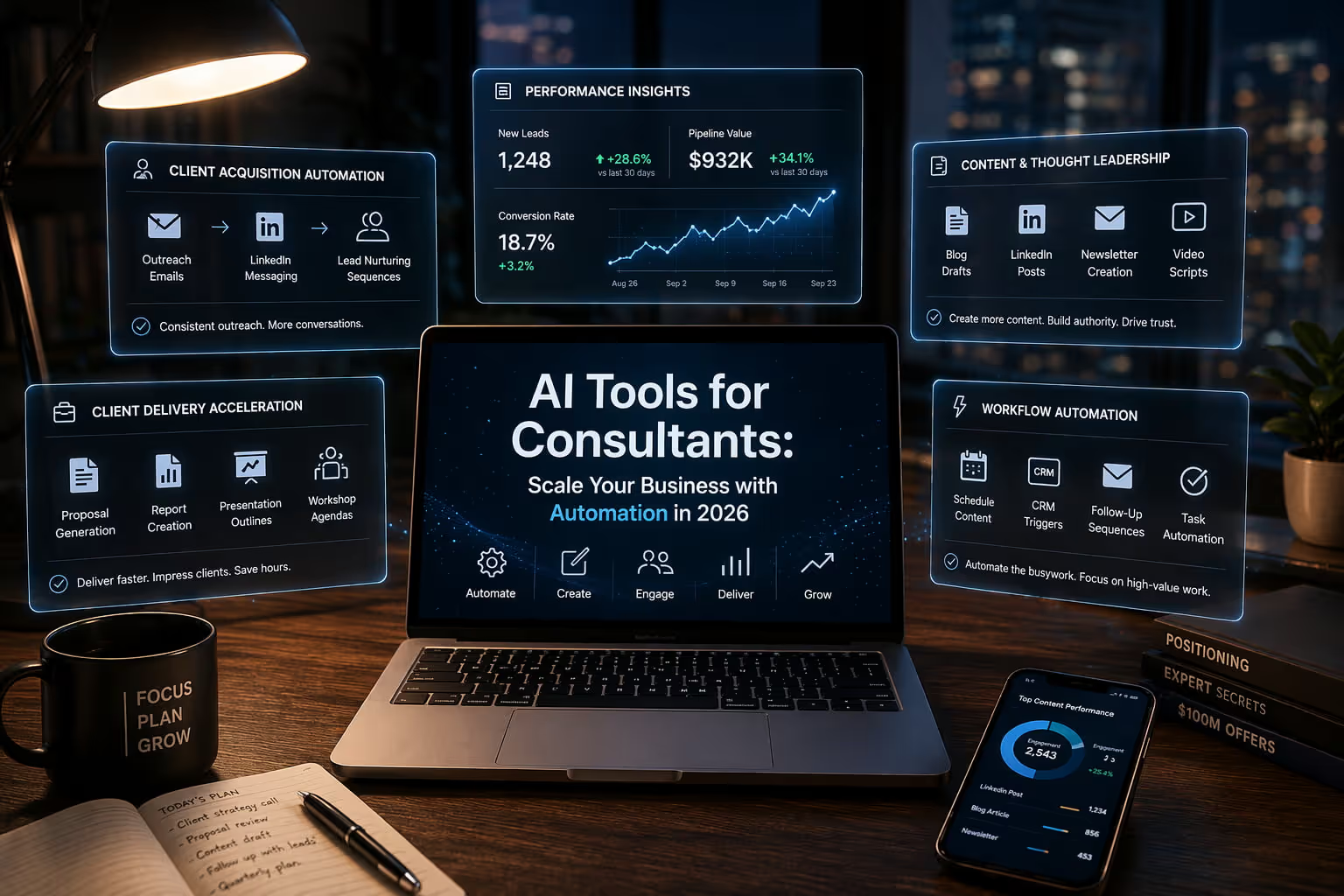
AI Tools for Consultants: How to Scale Your Consulting Business with Automation
Running a consulting business means constantly juggling two realities: delivering exceptional work for existing clients while simultaneously growing the pipeline for future ones.
For most consultants, that tension never fully resolves, until AI enters the picture. The rise of AI tools for consultants has fundamentally changed what's possible for independent practitioners and boutique firms alike.
With the right technology, you can scale your marketing, sharpen your communication, and grow your business without hiring a single additional person.
This article breaks down how AI is reshaping the consulting landscape, which use cases matter most, and how platforms like Blaze.ai are purpose-built to help consultants do more with what they already have.
Why Consultants Are Turning to AI
AI adoption in consulting isn't a trend driven by hype, it's a response to real, compounding pressures that make growth difficult without some form of leverage.
Time Constraints Limit Growth
Consulting is inherently a time-for-money model. Billable hours are the primary revenue driver, which means every hour spent on marketing, writing proposals, or drafting client updates is an hour not billed.
This creates a hard ceiling on growth. Without automation, most consultants find themselves in a perpetual cycle: when client work is heavy, business development suffers; when client work slows, there's nothing in the pipeline.
AI for consultants breaks this cycle by handling the time-intensive tasks that fall between client engagements, or that never get done at all.
Increasing Competition in Consulting
The consulting market has never been more crowded. The shift to remote work normalized hiring independent experts, lowering the barrier for new consultants to enter every niche from operations to brand strategy to financial advisory.
Visibility and differentiation are now table stakes. Consultants who can consistently show up in their prospects' feeds, inboxes, and search results hold a structural advantage.
Building that presence manually is prohibitively time-consuming, which is exactly why consulting business automation is becoming a competitive necessity, not a luxury.
Demand for Faster, Smarter Client Delivery
Client expectations have shifted too. Where a two-week turnaround on a strategic report once felt reasonable, clients now expect faster insights, more frequent touchpoints, and cleaner, more polished deliverables.
AI tools give consultants the capacity to meet these expectations without burning out, producing first drafts faster, generating structured reports from raw data, and maintaining communication cadences that would otherwise be unsustainable.
What "AI Tools for Consultants" Actually Includes
The term "AI tools for consultants" gets used broadly, so it's worth being precise. Depending on the use case, these tools fall into four main categories.
Marketing & Client Acquisition Tools
This is where the highest leverage tends to live for independent consultants. AI marketing tools for consultants handle content creation, blog posts, LinkedIn articles, thought leadership pieces, along with email campaigns, lead magnet copy, and landing page messaging.
Instead of staring at a blank page, consultants can generate a polished first draft in minutes and refine it to match their voice.
Client Delivery & Productivity Tools
AI also accelerates the work consultants are already doing for clients. Proposal drafting, report generation, workshop agendas, and presentation outlines can all be partially automated, dramatically reducing the time between engagement kick-off and first deliverable.
Communication & Engagement Tools
Consistent communication builds trust. AI tools help consultants maintain that consistency through automated follow-up sequences, client update emails, and newsletters, all without writing each message from scratch. The result is a more responsive, professional presence with significantly less effort.
Workflow Automation Tools
Beyond content creation, workflow automation tools handle the operational side of marketing: scheduling social posts, managing email sequences, and triggering follow-ups based on prospect behavior.
This layer of automation is what allows a one-person consulting practice to run marketing campaigns that look and feel like those of a much larger operation.
Key Use Cases for AI Tools in Consulting
Understanding the categories is useful. Seeing them in practice is more useful.
Building Thought Leadership
Thought leadership is the highest-value marketing asset a consultant can develop, and the one most consultants neglect because it requires consistent effort over a long time horizon.
AI tools make that consistency achievable. Consultants can use AI to draft weekly insights based on their frameworks, turn client wins into anonymized case studies, and systematically build a body of work that signals expertise in a specific niche.
Over time, this content compounds into a competitive moat that's very difficult for generalist competitors to replicate.
Scaling Content Marketing
One of the most powerful applications of AI for consultants is content multiplication. A single idea, a framework, an observation from a client engagement, a take on an industry trend, can be transformed into a LinkedIn post, a newsletter section, a blog introduction, and a short-form video script, all from one source.
This multi-format approach allows consultants to maintain a consistent posting cadence across platforms without generating entirely new ideas for each piece. The output looks prolific; the actual effort is far more contained.
Improving Client Acquisition
Automate client acquisition consulting workflows and you remove the single biggest reason consultants lose deals: inconsistent follow-up.
AI tools enable consultants to build outreach sequences that nurture cold leads over weeks or months, send timely check-ins to warm prospects, and deliver high-converting landing page copy that speaks directly to a target client's pain points.
The pipeline keeps moving even when the consultant is heads-down on a project.
Enhancing Client Delivery
Speed and polish are both hallmarks of strong client delivery. AI-assisted proposal creation means a well-structured, customized proposal can be ready within hours of a discovery call.
Reports come out cleaner and more consistent. Client communications strike the right tone. The cumulative effect is a delivery experience that feels premium, which directly supports higher rates and stronger referrals.
How AI Tools Help Consultants Scale Without Adding Headcount
Hiring is the traditional answer to a capacity problem. AI offers a different answer, one that doesn't come with payroll, onboarding time, or management overhead.
Increase Output Without Increasing Hours
The math is simple: if AI handles the first draft of every piece of content, every proposal, and every client update, a consultant can produce two to three times the output in the same number of hours.
More content means more visibility. Faster deliverables mean happier clients. Better responsiveness means fewer leads lost to slower competitors.
Build Systems Instead of Relying on Manual Effort
Sustainable scale requires systems, not heroics. AI tools allow consultants to build repeatable workflows, content templates, email sequences, proposal frameworks, that can be executed consistently regardless of how busy any given week gets.
This reduces cognitive load and eliminates the bottleneck that exists when everything depends on the consultant finding the time to sit down and write.
Focus on High-Value Activities
When AI handles the execution layer, consultants can focus on what only they can do: developing strategy, deepening client relationships, and closing new business. The shift from "doing" to "directing" is what transforms a consulting practice from a high-income job into a scalable business.
How Blaze.ai Helps Consultants Scale Their Business
Blaze.ai is built specifically for the kind of leverage described above, giving consultants a single platform to create, repurpose, and distribute content-driven marketing at scale.
AI-Powered Content Creation
With Blaze, consultants can generate blog posts, LinkedIn content, email campaigns, and ad copy in minutes. The platform is trained to maintain brand voice and adjust tone for different audiences, so the output doesn't feel generic.
Whether you're writing a thought leadership piece for a CFO audience or a nurture email for a startup founder, Blaze produces content that's on-message and ready to refine.
Repurpose Content Across Channels Instantly
This is one of Blaze's most practical capabilities for consultants. Take a long-form blog post and instantly extract a LinkedIn carousel, a newsletter intro, and three tweet-length insights, all formatted for their respective platforms.
The content multiplication that might take a marketing team a full day happens in minutes. For independent consultants operating without that team, this is a genuine force multiplier.
Automated Marketing Campaigns
Beyond individual content pieces, Blaze supports end-to-end campaign execution: email sequences that run on autopilot, social scheduling across platforms, and lead generation workflows that keep the pipeline moving.
Consultants who use Blaze effectively aren't just creating content, they're running a marketing operation that scales independently of their available hours.
Common Mistakes Consultants Make When Using AI
Adopting AI tools doesn't automatically produce results. The consultants who get the most value avoid a few predictable pitfalls.
Publishing Generic Content Without Differentiation
AI tools for consultants are only as useful as the inputs they're given. Prompting an AI to "write a LinkedIn post about leadership" will produce something forgettable.
Prompting it with a specific framework, a client observation, or a contrarian take produces content that actually builds an audience. The differentiation has to come from the consultant, AI amplifies the signal; it doesn't create it.
Over-Automating Without Personalization
Automation is a leverage tool, not a replacement for judgment. Sending the same follow-up sequence to every lead regardless of context, or publishing AI-generated content without reviewing it for accuracy and voice, erodes the trust that consulting businesses run on.
The best use of AI is to handle the heavy lifting while the consultant adds the final layer of personalization and perspective.
Ignoring Strategy in Favor of Volume
More content is not inherently better. A consultant who publishes five mediocre posts a week is not outperforming one who publishes one genuinely useful insight. AI makes volume easy; strategy determines whether that volume translates into pipeline.
Define your content pillars, your target audience, and your conversion goals before scaling output.
Not Aligning Content with Offers
Content that doesn't connect to a specific service or engagement type is brand awareness with no payoff. Every piece of content should have a logical next step, a lead magnet, a discovery call, a free resource, that moves a reader closer to becoming a client. When consulting business automation is deployed without this alignment, it generates traffic without generating revenue.
The ROI of AI Tools for Consultants
The case for investing in AI marketing tools for consultants ultimately comes down to measurable outcomes.
Increased Lead Generation
Consistent content and automated outreach mean more touchpoints with more prospects over time. Consultants who publish regularly and maintain active follow-up sequences generate more inbound inquiries, without increasing their active selling time.
Higher Client Conversion Rates
Speed matters in the sales process. Consultants who respond quickly with polished proposals, personalized follow-ups, and clear, professional communication convert at higher rates than those who take days to respond because they're manually drafting every message.
More Consistent Revenue
Feast-or-famine cycles are the norm in consulting precisely because business development gets neglected during busy delivery periods. Automated marketing campaigns keep the pipeline moving regardless of current workload, smoothing revenue and reducing the anxiety that comes with unpredictable income.
Reduced Time Spent on Marketing
The hours saved by automating content creation, email follow-up, and social scheduling add up quickly. Many consultants report reclaiming 5 to 10 hours per week after integrating AI tools, hours that can be redirected toward billable work, strategy, or rest.
Manual vs. AI-Assisted Consulting Workflow: A Quick Comparison
Activity
Manual Approach
AI-Assisted Approach
Writing a blog post
3–5 hours
30–60 minutes
Drafting a proposal
2–4 hours
30–45 minutes
Building an email sequence
4–6 hours
1–2 hours
Repurposing one piece of content
1–2 hours per format
10–15 minutes per format
Social media scheduling
Weekly manual effort
Fully automated
Future Trends: AI and the Evolution of Consulting
The current wave of AI tools is just the beginning. The consultants who build competency now will be well-positioned as the technology continues to evolve.
AI-Augmented Strategy Development
The next generation of AI tools will move beyond content generation into strategic analysis, synthesizing market data, competitive intelligence, and client performance metrics to support better strategic recommendations. Consultants who leverage these tools will deliver sharper insights faster.
Real-Time Content & Insight Generation
As AI models become faster and more integrated with live data sources, consultants will be able to generate client-facing insights in real time during meetings, in response to breaking market developments, or as part of ongoing advisory relationships. The speed of insight delivery will become a differentiator in its own right.
Hyper-Personalized Client Experiences
AI will increasingly enable consultants to personalize client communication at a level that was previously only possible with large teams. Every touchpoint from onboarding emails to check-in calls to report formats, can be tailored to individual client preferences and communication styles, deepening relationships and improving retention.
Integration with CRM and Business Systems
The most powerful near-term evolution is tighter integration between AI content tools and CRM platforms. When Blaze-generated content is connected to pipeline data, consultants can trigger the right message to the right prospect at exactly the right moment, making outreach feel timely and relevant rather than generic.
Final Thoughts: AI as a Growth Lever for Consultants
The consultants winning right now aren't necessarily the most talented. They're the ones who've figured out how to scale their expertise, how to be present in more conversations, with more prospects, more consistently, without working more hours.
AI tools for consultants make that possible. They replace the manual, repetitive work that keeps most practitioners stuck below their growth ceiling with systems that run independently, maintain quality, and keep the pipeline moving.
The shift isn't about working less. It's about working on the right things, strategy, relationships, delivery, and letting automation handle everything else. That's the difference between a consulting practice and a consulting business.
If you're ready to stop trading hours for output and start building real leverage, Blaze.ai is worth exploring. It's built for exactly this: giving consultants the marketing engine they need to scale without the overhead of a team to run it.